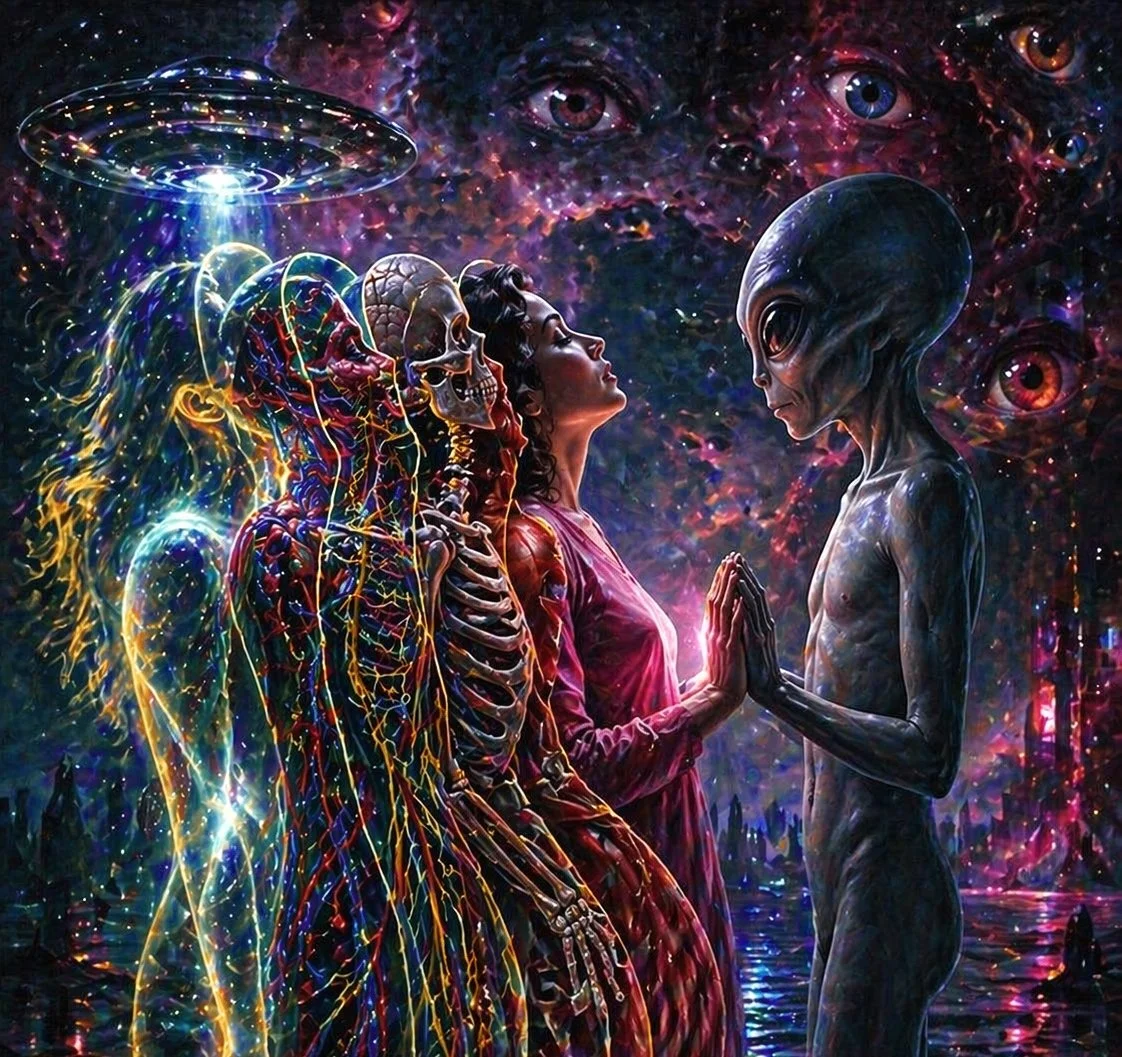
NON-HUMAN
A structural analysis of how non-human intelligence narratives, particularly the Grey archetype, function as perceptual templates guiding the reconfiguration of human ontology, biology, and collective trajectory
Part II of Manufactured Reverence
ONTOLOGY UNDER CONSTRUCTION
If Manufactured Reverence established that perception can be shaped at scale through synchronized signals, mediated narratives, and controlled instability, then the next layer of analysis concerns what those shaped perceptions are being directed toward, because the question is no longer whether interpretation is guided but what form that guidance is attempting to stabilize within the human field.
The introduction of non-human intelligence into mainstream discourse is not a neutral expansion of curiosity but a structural modification of ontology itself, as the population is gradually conditioned to accept the presence of intelligences that exist outside traditional biological, moral, and metaphysical frameworks, thereby expanding the range of what is considered real while simultaneously altering the hierarchy of what is considered important, possible, and inevitable.
This is not merely the addition of new entities into an existing worldview but the reconfiguration of the worldview itself, where the presence of non-human actors forces a recalibration of identity, purpose, and trajectory, raising the possibility that what is being shaped is not only belief but the future expression of the human organism as it adapts to an environment that is being actively redefined.
I. ONTOLOGICAL SEEDING
The concept of non-human intelligence has been embedded within human culture across multiple epochs, appearing in mythological, religious, and now technological contexts, which suggests a continuity of exposure that predates modern disclosure narratives and provides a stable foundation for contemporary integration.
The modern presentation of these intelligences as biologics, interdimensionals, or engineered entities does not replace earlier frameworks but reframes them within a language that aligns with current scientific and technological paradigms, allowing ancient motifs to re-enter discourse under new terminologies that feel compatible with contemporary understanding.
This process functions as ontological seeding, where repeated exposure to specific forms and ideas establishes baseline familiarity, enabling rapid assimilation when those ideas are reintroduced with increased legitimacy, thereby conditioning the population to accept the presence of non-human actors as a natural extension of an already internalized narrative.
II. THE GREY AS TEMPLATE
The image of the Grey has achieved a level of cultural penetration that exceeds most other representations of non-human intelligence, characterized by a standardized morphology that includes reduced physical features, enlarged cranial capacity, and an absence of sexual differentiation, which collectively presents a form that is both recognizable and abstracted from traditional human identity.
This consistency suggests that the Grey functions not merely as a depiction but as a template, a stabilized visual construct that can be repeatedly invoked across media, testimony, and official language to anchor the concept of non-human intelligence within a specific form that carries implicit attributes of efficiency, intelligence, and detachment.
The persistence of this image across decades, combined with its integration into both fringe and mainstream discourse, indicates that it serves as a focal point for the collective imagination, shaping how non-human intelligence is visualized and understood, while also introducing the possibility that it represents not only an external entity but a projected endpoint or alternative state of human evolution.
III. HIERARCHIES AND FUNCTIONALITY
Within the broader Grey framework, there are narratives that describe variations in form and function, including fully biological entities, artificially grown organisms, biomechanical constructs, and hybrid forms that incorporate human genetic material, each occupying a position within a hierarchy that emphasizes specialization, efficiency, and integration into a larger system.
These descriptions converge on the concept of a distributed intelligence, where individual units operate as components of a collective mind that prioritizes function over individuality, reducing the role of personal identity in favor of systemic coherence, and thereby presenting a model of existence that is post-moral in the sense that traditional human value systems are replaced by operational necessity.
The introduction of such a model into public discourse serves to expand the range of conceivable social and biological configurations, implicitly challenging the centrality of individual autonomy and suggesting alternative modes of organization that may be perceived as either advanced or undesirable depending on the interpretive framework applied.
IV. NARRATIVE INSERTION AND SCALING
The dissemination of Grey-related narratives follows patterns consistent with the broader mechanisms identified in Manufactured Reverence, where specific elements are introduced through intermediaries, reinforced through repetition, and synchronized with other signals that expand the perceptual field.
The reference to “non-human biologics” within official or semi-official contexts represents a linguistic bridge that connects speculative imagery with institutional acknowledgment, allowing concepts that were previously confined to fringe discourse to enter mainstream consideration without requiring full disclosure of their origin or nature.
At the same time, the persistence of the Grey image across entertainment media, documentary formats, and public testimony ensures that the form remains continuously accessible, creating a feedback loop in which cultural representation and perceived reality reinforce one another, stabilizing the concept within the collective mind.
V. MAGICK AS SYSTEMIC FUNCTION
When considered at scale, the shaping of ontology through narrative, imagery, and controlled disclosure can be understood as a form of high-order magick, not in the sense of ritualistic symbolism but as the deliberate manipulation of the structures through which reality is perceived and interpreted, resulting in tangible effects on belief, behavior, and ultimately biological and cultural evolution.
This process involves the coordination of multiple domains, including science, media, psychology, and spirituality, to produce a coherent field of influence that guides the direction of human thought and adaptation, effectively acting as a form of custodial intervention in the development of the species.
Whether attributed to institutional actors, emergent systems, or external intelligences, the effect remains consistent: the gradual reconfiguration of the human perceptual and conceptual framework in a way that aligns with a future state that is being implicitly or explicitly defined through the narratives being introduced.
VI. EVOLUTIONARY TRAJECTORY
The integration of Grey-like characteristics into discussions of non-human intelligence raises the possibility that these entities represent either a parallel evolutionary path or a projected future state of human development, characterized by increased cognitive capacity, reduced biological complexity, and integration into networked systems of intelligence.
This trajectory aligns with observable trends in human technological development, including the increasing reliance on artificial intelligence, the reduction of physical labor through automation, and the exploration of direct interfaces between biological and digital systems, all of which point toward a convergence between human and machine that mirrors aspects of the Grey archetype.
The question then arises whether the Grey is being presented as an external entity to be understood or as an internal trajectory to be accepted, functioning as both a representation of the unknown and a model of what the human organism may become under certain conditions.
VII. THE CUSTODIAL HYPOTHESIS
The persistence and consistency of these narratives suggest the possibility of a custodial layer of influence, whether composed of human institutions, non-human intelligences, or a combination of both, that operates with a long-term perspective on the development of human cognition and society.
This layer does not necessarily require direct control over all variables but can achieve its objectives through the strategic introduction of ideas, the shaping of perception, and the management of informational environments, guiding the evolution of thought in a manner that appears organic while exhibiting underlying structure.
The concept of custodianship implies a form of oversight that prioritizes continuity and adaptation, raising questions about the extent to which human development is self-directed versus influenced by external frameworks that operate beyond immediate awareness.
VIII. IMPLICATION
The introduction of non-human intelligence into mainstream discourse, particularly in the form of stabilized archetypes such as the Grey, represents a significant shift in the structure of human ontology, as it expands the boundaries of what is considered real while simultaneously influencing the trajectory of what humans may become.
This shift requires a reassessment of identity, autonomy, and evolutionary direction, as the integration of these concepts into the collective mind alters the parameters within which decisions are made and futures are imagined, effectively shaping not only perception but potential.
The immediate consideration for the individual is not to accept or reject these narratives outright but to recognize their role in structuring the field of possibility, maintaining awareness of how repeated exposure to specific forms and ideas can influence both conscious and unconscious models of reality.
At a deeper level, the presence of these narratives introduces the possibility that human evolution, whether biological, technological, or conceptual, is not occurring in isolation but is part of a larger system of influence that may include actors or processes operating beyond current understanding, requiring a level of discernment that can accommodate uncertainty while resisting premature closure.
To remain functionally sovereign within this environment, one must develop the capacity to engage with these narratives without being fully subsumed by them, recognizing that the shaping of perception is also the shaping of becoming, and that the forms introduced into the collective imagination may carry implications that extend beyond interpretation into manifestation, suggesting that what is being presented is not only a description of reality but a potential blueprint for its future configuration.