MANAGED REVELATION
A Psychological and Civilizational Analysis of How Governments, Religious Institutions, Technology Corporations, and Intelligence Structures Prepare Populations for Radical Ontological Revision
For nearly a century, unidentified aerial phenomena occupied a carefully maintained psychological quarantine within Western civilization: visible enough to persist culturally, absurd enough to remain institutionally disposable, sensational enough to monetize, contaminated enough to prevent serious inquiry. The subject survived through ridicule management, compartmentalization, selective leakage, media contamination, intelligence interference, religious ambiguity, and the gradual construction of a social reflex in which even discussing the possibility of anomalous intelligences carried reputational cost. This produced a stable ontological perimeter around the phenomenon. UFOs existed, but only as entertainment, delusion, fringe spirituality, Cold War mythology, or tabloid residue. The perimeter remained remarkably durable until the precise moment major institutions began dismantling it themselves. What has emerged since is not disclosure in the classical sense of suppressed truths suddenly escaping containment, but something more structurally coherent and psychologically sophisticated: a controlled alteration of acceptable reality boundaries through synchronized institutional signaling, strategic ambiguity, emotional calibration, and narrative acclimation. The phenomenon under examination is therefore not merely anomalous craft or non-human intelligence, but the coordinated behavioral architecture surrounding their introduction into public consciousness.
The current environment bears almost none of the characteristics expected from a genuinely uncontrolled ontological rupture. If governments truly possessed confirmed evidence of superior non-human agencies interacting with humanity in ways capable of destabilizing religion, economics, anthropology, military hierarchy, evolutionary assumptions, and human self-concept simultaneously, one would expect either continued suppression or acute institutional urgency. Instead, the modern Disclosure environment proceeds with a strange tonal softness. Congressional hearings unfold with procedural calm. Intelligence officials smile casually while discussing objects violating known aerospace constraints. News graphics package potentially civilization-altering implications into digestible infotainment segments between advertisements. Former military and intelligence personnel deliver carefully incomplete testimony calibrated to sustain fascination without producing epistemic closure. Grainy targeting footage once considered catastrophic to release now circulates as serialized media spectacle through outlets like NewsNation, accompanied by polished graphics and emotionally flattened presentation aesthetics that subtly normalize the extraordinary through repetition. The contradiction is glaring: the implications remain existential while the emotional framing remains managerial. This is not the psychological signature of institutions losing control of reality. It is the signature of institutions administering it.

Contemporary broadcast framing surrounding unidentified anomalous phenomena.
This distinction becomes clearer once one recognizes that the modern Disclosure apparatus functions less as declassification than as interpretive infrastructure. The public is not being handed conclusions; it is being conditioned into conceptual proximity with previously prohibited categories while simultaneously being supplied approved emotional and metaphysical responses to those categories. Unknown craft. Non-human intelligence. Interdimensionality. Consciousness. Angels. Demons. Quantum anomalies. Simulation. Spiritual warfare. Threat vectors. These terms circulate continuously through podcasts, congressional testimony, military briefings, entertainment media, algorithmic feeds, and religious discourse without ever stabilizing into a coherent explanatory framework. That instability is operationally useful. An unresolved phenomenon possesses extraordinary psychological flexibility because multiple demographic groups can project themselves into it simultaneously without institutions committing to a singular ontology. Religious populations interpret the phenomenon through eschatology and spiritual warfare; technologists through futurism and posthumanism; defense sectors through threat analysis and aerospace vulnerability; spiritual subcultures through awakening narratives and consciousness evolution; intelligence communities through ambiguity management and social calibration. The phenomenon remains undefined precisely because definition would collapse strategic elasticity.
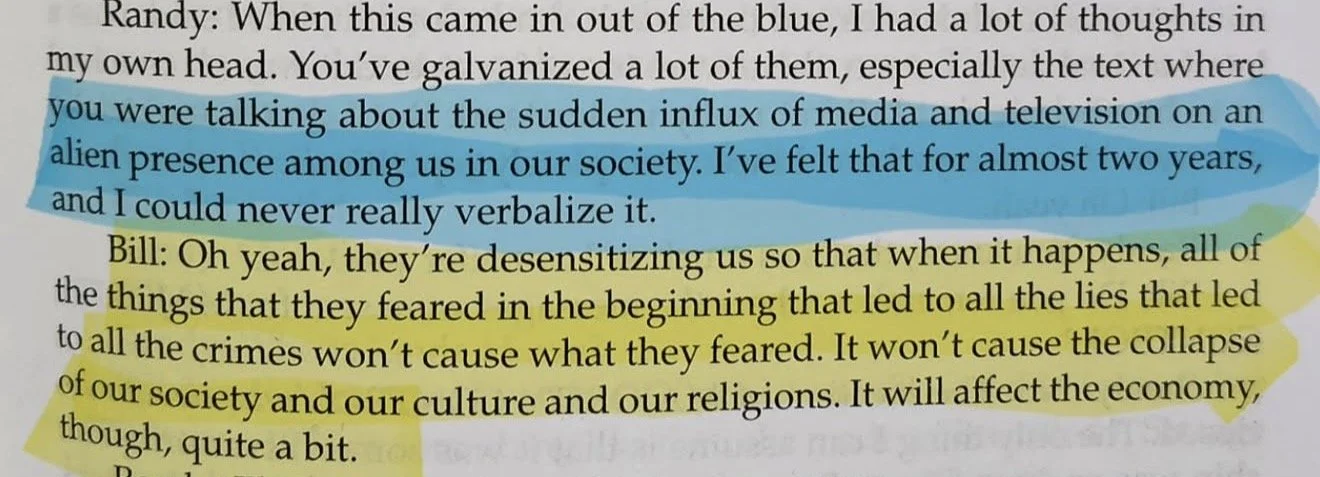
The result is a condition best understood as ontological gradualism: the slow introduction of cognitively destabilizing concepts into consensus culture in concentrations carefully measured to prevent civilizational shock. Whitley Strieber articulated a version of this years ago during a discussion concerning the sudden proliferation of alien imagery and media saturation surrounding non-human presence. “They’re desensitizing us,” he remarked, suggesting that the sustained influx of alien themes through television, media, and public discourse functioned as acclimation against the very societal collapse institutions once feared would accompany revelation. Whether one agrees with Strieber’s interpretation is secondary to the larger observation now visible across the cultural landscape: anomalous intelligences have transitioned from fringe contamination into continuous atmospheric presence within mainstream informational systems. Streaming media, military footage releases, congressional inquiries, Vatican procedural revisions, AI-generated anomalies, spiritual warfare rhetoric, and intelligence-adjacent celebrity intermediaries now form a single uninterrupted ontological environment in which ambiguity itself becomes normalized. The public is gradually learning to emotionally coexist with uncertainty regarding humanity’s position within possible intelligence hierarchies.
The institutional behavior surrounding this transition reveals remarkable semantic discipline. Sean Kirkpatrick’s testimony before Congress that there existed no evidence of extraterrestrial visitation or extraterrestrial craft was widely interpreted as categorical denial. The wording deserves more scrutiny than it received. “Extraterrestrial” is an extremely narrow classification. It excludes extradimensional models, cryptoterrestrial hypotheses, temporally displaced intelligences, engineered biological entities, non-biological cognition, consciousness-linked phenomena, or categories outside publicly available scientific vocabulary. A sufficiently informed institution could technically deny extraterrestrial involvement while still possessing knowledge of realities profoundly incompatible with mainstream material assumptions. This creates an epistemic asymmetry in which the public believes only two categories exist — either the phenomenon is entirely fictitious or it represents literal visitors from another planet — while institutions potentially operate from a far more exotic taxonomy unavailable to civilian cognition. The public debates spacecraft while remaining structurally excluded from the conceptual architecture necessary to interpret official statements accurately. This allows technically truthful denials to coexist comfortably alongside radical informational asymmetry.

Simultaneously, the phenomenon is being integrated into defense and technological infrastructure at extraordinary speed. One recent symbolic convergence encapsulates the shift almost perfectly: the Department of War entering operational partnerships with major artificial intelligence firms including OpenAI, Google, Microsoft, Amazon Web Services, NVIDIA, Oracle, SpaceX, and Reflection AI for “lawful operational use.” The significance lies not in simplistic accusations of conspiracy but in the convergence itself. During the precise historical moment anomalous intelligence narratives are being normalized publicly, the informational nervous system of civilization is becoming inseparable from military-grade predictive systems, algorithmic mediation, orbital infrastructure, AI-enhanced surveillance, synthetic cognition, and behavioral modeling architectures. Defense no longer concerns merely territory or conventional adversaries; it increasingly concerns informational sovereignty, predictive dominance, perception management, and continuity stabilization within an environment of accelerating ontological instability. The symbolic migration from Department of Defense to Department of War language becomes psychologically revealing here because the terrain under administration increasingly resembles reality perception itself.
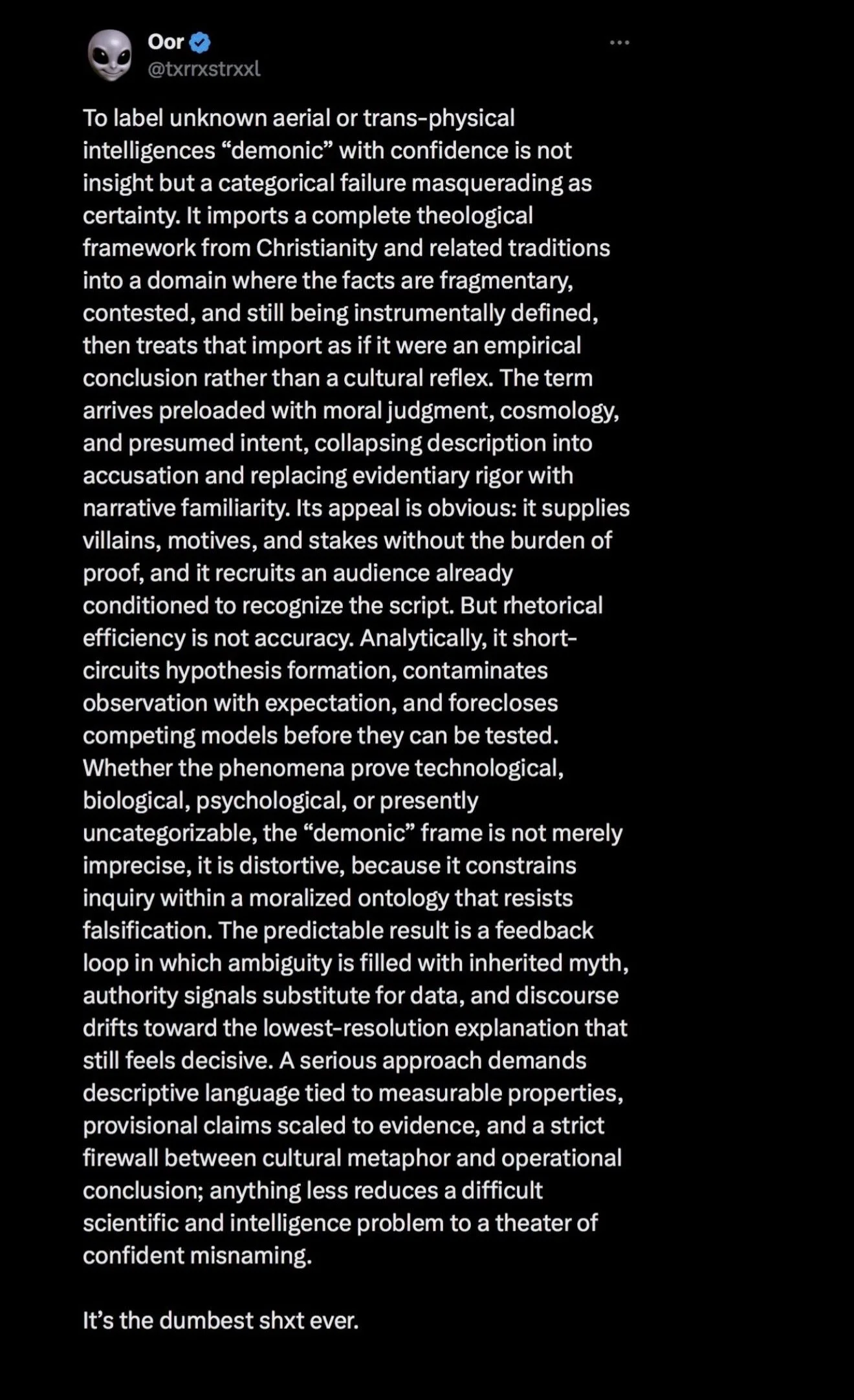
The theological dimensions of this transition are equally revealing and perhaps even more dangerous analytically. Increasingly, anomalous phenomena are framed publicly through explicitly religious categories, particularly within Christian discourse emphasizing angels, demons, prophecy, possession, apocalypse, and spiritual warfare. This framing is intellectually catastrophic from an epistemological standpoint because it imports an entire preloaded cosmological architecture into a domain where the evidentiary substrate remains radically incomplete. To label unknown aerial or trans-physical intelligences “demonic” with confidence is not insight but categorical collapse masquerading as certainty. The term arrives carrying inherited moral judgments, presumed intent, metaphysical binaries, teleological assumptions, and culturally conditioned narrative reflexes that transform ambiguity into accusation before empirical stabilization has occurred. It replaces observation with inherited mythic familiarity. Its appeal is obvious because it supplies villains, motives, and stakes without requiring proof, and recruits populations already conditioned to recognize the symbolic script. Yet rhetorical efficiency is not analytical rigor. Such framing contaminates hypothesis formation, constrains inquiry within unfalsifiable theological boundaries, and forecloses competing interpretive models before meaningful investigation becomes possible. The predictable result is a feedback loop in which ambiguity becomes filled with inherited mythology, authority signals substitute for evidence, and public discourse drifts toward the lowest-resolution explanation capable of still feeling emotionally decisive.

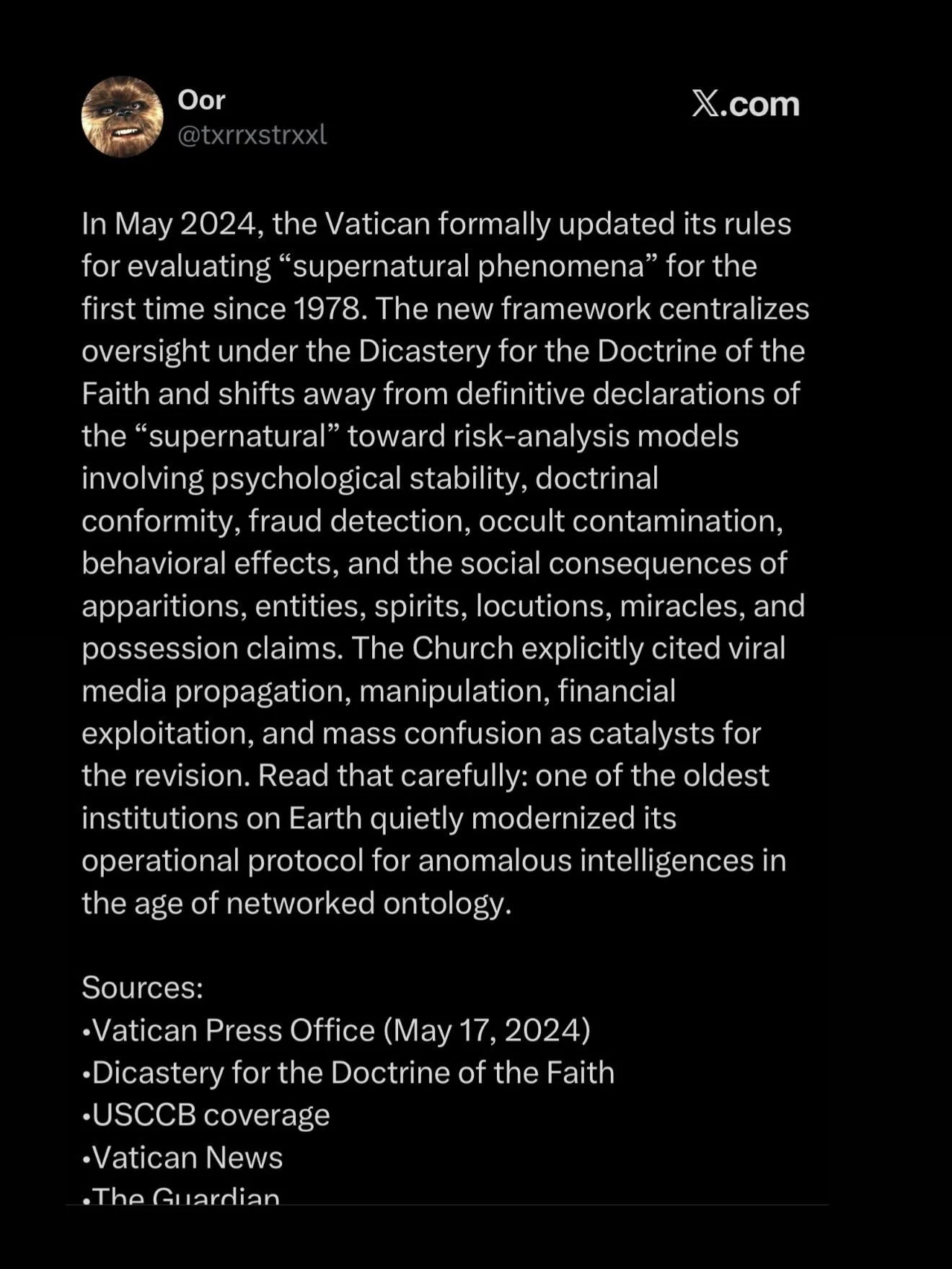
The timing of this religious convergence becomes even more interesting when examined alongside institutional behavior from the Vatican itself. In May 2024, for the first time since 1978, the Vatican formally revised its procedural framework for evaluating supernatural phenomena through the Dicastery for the Doctrine of the Faith. The revisions shifted emphasis away from definitive declarations of supernatural authenticity and toward risk-analysis models focused on psychological stability, doctrinal conformity, fraud detection, occult contamination, viral media propagation, financial exploitation, behavioral consequences, and mass confusion surrounding apparitions, miracles, entities, spirits, possession claims, and anomalous experiences. This development is historically extraordinary regardless of one’s religious orientation. One of the oldest continuity-preserving institutions on Earth quietly modernized its operational response protocols for anomalous intelligences during the same cultural window in which governments, media systems, defense sectors, AI corporations, and intelligence-adjacent personalities collectively intensified discourse surrounding non-human presence and ontological uncertainty. The Church explicitly acknowledged viral propagation and memetic destabilization as variables requiring management. In other words, reality itself has become networked. Ontology now spreads socially at algorithmic speed. The Vatican is no longer merely evaluating miracles; it is adapting to conditions of mass ontological contagion.
Even narratives concerning churches being privately briefed regarding potential UFO disclosures, whether entirely factual or partially mythologized, reveal something historically important independent of verification: such scenarios now feel psychologically plausible to large portions of the public. Thirty years ago the concept would have been relegated almost entirely to fringe subcultures. Now it feels adjacent to mainstream expectation. This shift alone demonstrates how radically the perceptual atmosphere has changed. The population has been conditioned into cognitive tolerance for possibilities previously considered socially radioactive.
The most important feature of the current Disclosure environment is therefore not the anomalous phenomena themselves but the systematic management of public response to them. The public is being acclimated to several deeply destabilizing ideas simultaneously: that humanity may not occupy the apex position within intelligence hierarchies; that consciousness may exceed materialist assumptions; that governments possess radically asymmetrical knowledge; that unseen agencies may operate adjacent to civilization; that perception itself may be incomplete; that reality categories previously dismissed as mythology may overlap with domains of legitimate institutional concern. These are not minor cultural adjustments. They represent civilizational recalibration pressures operating directly upon the foundational assumptions organizing modernity.
Yet the rollout remains strangely theatrical. Podcasts monetize ontological anxiety through serialized speculation. Intelligence-adjacent personalities become celebrity intermediaries carrying quasi-prophetic authority within online ecosystems. Carefully selected whistleblowers emerge possessing enough credibility to maintain public fixation while remaining sufficiently constrained to avoid epistemic rupture. Information arrives perpetually incomplete, sustaining anticipation without closure. The population enters a suspended cognitive state in which uncertainty itself becomes addictive. Attention centralizes around institutions and personalities claiming proximity to hidden knowledge while ambiguity continuously regenerates dependency. This resembles neither transparent governance nor spontaneous revelation. It resembles narrative entrainment.
The uncomfortable possibility emerging from this analysis is that the architects of this process may not perceive themselves as malicious actors at all. They may genuinely believe unmanaged ontological shock would fracture social cohesion catastrophically. Raw confrontation with radically non-human realities, superior intelligences, manipulated histories, or unstable metaphysical conditions could potentially destabilize religion, economics, governance, and collective identity simultaneously. Civilization depends heavily upon continuity illusions and stable symbolic systems. Currency itself functions primarily through collective faith abstraction. Governments already manage reality psychologically through media framing, educational conditioning, mythic nationalism, emotional synchronization, and narrative continuity systems. Under such conditions, controlled disclosure, strategic ambiguity, symbolic acclimation, theological preloading, and emotional calibration would appear not as deception but as continuity preservation mechanisms. This does not make the operation honest. It makes it intelligible.
And this perhaps explains the extraordinary contradictions saturating the present moment: revelation without revelation, urgency without urgency, threat without attack, spirituality without theology, disclosure without clarity, evidence without conclusion, warning without context, and mystery administered in carefully measured doses through the combined machinery of governments, media systems, technological infrastructure, religious adaptation, algorithmic amplification, and defense-sector language. The phenomenon itself increasingly appears secondary to the management of human cognition surrounding the phenomenon.
Actual open contact, should such a thing occur, would almost certainly exceed the containment architecture currently surrounding Disclosure culture. Real ontological rupture would not behave like serialized infotainment distributed through congressional hearings, social media feeds, sanitized military footage, smiling officials, or podcast circuits. It would destabilize financial systems, fracture religious certainty, challenge political legitimacy, collapse anthropocentric assumptions, and produce immediate epistemological crisis conditions across every domain simultaneously. Nothing about the current rollout appears structurally designed to survive such an event. Which leaves two possibilities equally worthy of consideration: either no imminent ontological rupture exists at all, or the current operation serves functions other than truthful preparation. In either case, what is unfolding publicly should not be mistaken for simple transparency. It is something far more sophisticated and historically unprecedented: the managed regulation of reality mutation within the collective human mind.