ONTOLOGICAL SHOCK
Ontological shock occurs when the assumptions that quietly organize meaning, value, and motivation are no longer reliable. It is not merely the introduction of new information, but the destabilization of the interpretive structures that once rendered life coherent and future-oriented. Human societies, particularly in the modern era, have been organized around an unspoken confidence that reality ultimately bends toward human centrality, human sovereignty, and human-defined flourishing. Even when hardship is acknowledged, there remains an implicit trust that meaning itself is aligned with us, that the universe is, in some ineffable way, rooting for our comfort.
On the Notion of Shock and the Duty of Maturity Regarding Disruptive Revelation
Introduction
This essay is written as a continuation. It assumes the conceptual groundwork laid in The Reincarnation Machine and Phenological Continuity and proceeds from the position that their central premises are not speculative curiosities but propositions serious enough to demand consequence. Those prior works explored systems of continuity, custodianship, recursion, and the unsettling possibility that human life exists within a managed ecology of consciousness rather than at the apex of creation. What they intentionally restrained was a sustained engagement with the human interior response to that possibility. This essay exists to address that absence.
What follows is not an attempt to persuade, frighten, or comfort. It is an attempt to speak directly to the condition that emerges when the ground of truth shifts beneath the feet of a species accustomed to standing upright in a flattering story. Ontological Shock is not a media problem, a messaging problem, or a matter of insufficient education. It is a biological, psychological, and civilizational condition, a tremor felt not in institutions first, but in the subtle architecture of meaning itself. Treating it lightly, or treating it cosmetically, is itself a form of danger.
The call being made here is a call to comportment, to maturity, and to civic responsibility under conditions that do not reassure us. This is an appeal grounded in necessity, rather than sentiment, showing gentle respect for the scale of what we’re beginning to glimpse.
Shock and the Collapse of Comfort
Ontological shock occurs when the assumptions that quietly organize meaning, value, and motivation are no longer reliable. It is not merely the introduction of new information, but the destabilization of the interpretive structures that once rendered life coherent and future-oriented. Human societies, particularly in the modern era, have been organized around an unspoken confidence that reality ultimately bends toward human centrality, human sovereignty, and human-defined flourishing. Even when hardship is acknowledged, there remains an implicit trust that meaning itself is aligned with us, that the universe is, in some ineffable way, rooting for our comfort.
If the propositions explored in my prior essays are even partially correct, that confidence is misplaced.
What emerges instead is a far less sentimental picture, though not an ungracious one. Intelligence appears to operate at scales of time, purpose, and recursion that do not prioritize human comfort, and may not even recognize it as a relevant variable. This does not imply cruelty, but demonstrates indifference to our emotional expectations, the same indifference shown by gravity, by seasons, by birth and death themselves. Instinct, however, reacts to this indifference as if it were hostility.
Shock is not the mind struggling to understand. Shock is the body responding to the sudden loss of orientation, the moment when the internal compass spins without settling. Fear, rage, denial, submission, and compulsive meaning-making arise not because the truth is unbearable, but because instinct is optimized for immediate survival within narrow environments. It is not optimized for cosmic scale, managed systems, or the possibility that incarnation itself is a temporary arrangement within a much larger choreography of becoming.
This is where danger begins. Not in the knowledge itself, but in the instinctive behaviors that knowledge provokes. Civilizations do not fracture first at the level of philosophy. They fracture at the level of reflex. When comfort ceases to function as an organizing principle, humans often respond by moralizing harder, clinging tighter to identity, or abandoning responsibility altogether. None of these responses are adaptive at scale, and none honor the intelligence that brought us to this threshold.
The necessity, then, is not reassurance, but discipline. The cultivation of demeanor under conditions where comfort is no longer guaranteed and may never return in the form we expect. This is not a loss of meaning. It is an invitation to a deeper, less sentimental one.
Revelation
A persistent fantasy within disclosure discourse is the idea of a singular event, a moment of revelation that resolves uncertainty and allows society to move forward cleansed of ambiguity. This fantasy misunderstands both human psychology and the nature of revelation itself. What we are experiencing is not an event, but a condition, one that unfolds gradually, unevenly, and without closure, like a dawn that never quite becomes noon.
We already inhabit this condition. Senior military and state institutions now speak openly about Non-Human Intelligence (NHI/E.T.s) as a matter of public record and under-oath testimony. This is neither satire nor marginal speculation. It is acknowledged in hearings, briefings, and official statements. Whether one interprets this as partial truth, strategic disclosure, or psychological operation is secondary to the fact that the implication space has been opened and cannot be closed. A door has been left ajar, and the draft is already changing the temperature of the room.
Decades ago, Ronald Reagan articulated this implication with remarkable clarity in an address to the United Nations General Assembly:
“I occasionally think how quickly our differences worldwide would vanish if we were facing an alien threat from outside this world. And yet, I ask you, is not an alien force already among us? What could be more alien to the universal aspirations of our peoples than war and the threat of war?”
The enduring value of this statement lies not in its theatrical imagination, but in its psychological precision. Human conflict, identity, and cooperation are downstream of perceived context. Alter the frame in which humanity understands itself, and behavior must either evolve or fracture. The cosmos does not need to invade for this transformation to occur. It need only be acknowledged.
Aside: Long before the United States formally entered World War II, the public mind was carefully prepared through a sequence of speeches that never declared war outright, yet steadily reframed neutrality as naïve, danger as proximate, and moral obligation as unavoidable. From Roosevelt’s Quarantine Speech through the Arsenal of Democracy address and the Four Freedoms, the state did not announce intent so much as cultivate inevitability, acclimating perception to the idea that an external threat could collapse internal divisions and justify extraordinary alignment. Reagan’s later invocation of an extraterrestrial threat at the United Nations follows this exact rhetorical lineage: a prod at perception. It functions as a tell. A speculative external adversary is introduced not to rehearse unity, to test whether the public can be made to think at the species level, and to inoculate the psyche against future framing in which motives, intentions, and actions of a non-human “other” are pre-contextualized as unifying, corrective, and necessary. As with WWII, the speech comes before the door opens. The mind is conditioned first, the meaning is supplied later, and when the trigger event arrives everyone plays along.
We are now in the most unstable phase of this process. Not ignorance, and not certainty, but accumulation. Partial disclosures, cultural saturation, rumor, confirmation, denial, and speculation layered over months and years. This is the phase in which fear outpaces integration and imagination outruns ethical grounding. It is also the phase in which the greatest damage can be done if instinct is allowed to govern unchecked, mistaking acceleration for insight.
The appropriate response to this condition is not obsession, nor dismissal, but preparation. Preparation for the implications. For the possibility that what eventually becomes undeniable will not arrive cleanly, nor resolve itself neatly, but will confront us already steeped in anxiety, anger, grief, and half-formed narratives. The question then becomes unavoidable: what does a sane way forward look like once the shock has already occurred and the old map no longer matches the terrain?
Intelligence before maturity and the memory of imbalance
Across cultures, eras, and symbolic systems, a recurring pattern appears: intelligence arrives before maturity. Whether expressed as fallen angels, Watchers, archons, civilizing gods, or forbidden knowledge, the structure of the story remains remarkably consistent. Tools, insight, or power are introduced into a system before the recipients possess the psychological, ethical, or social maturity required to integrate them without distortion. The myth remembers what history repeats.
This pattern should not be dismissed as primitive superstition. It is a developmental truth encoded symbolically, a warning written in the language of dream and scripture. Human instinct evolved to navigate scarcity, predators, kin loyalty, and short time horizons. It did not evolve to metabolize recursive lifetimes, managed ecologies of consciousness, or intelligence operating outside linear time. When confronted with such ideas, instinct does not reason. It reacts, and reaction is rarely wise.
This is where the danger of ontological shock intensifies. Faced with the possibility that we exist within a managed system, many will externalize responsibility, framing themselves as livestock, victims, or pawns devoid of agency. Others will sacralize authority, treating any perceived higher intelligence as morally superior and therefore deserving of obedience. Still others will justify cruelty or domination as realism, mistaking detachment for wisdom and power for alignment.
Here, the relevance of Nietzsche becomes unavoidable. In Beyond Good and Evil, Nietzsche was not announcing the triumph of amorality, but diagnosing the human response to the collapse of shared moral frameworks. He understood that when inherited meaning structures dissolve, most people do not become freer. They become reactive. Moral certainty increases as epistemic stability decreases. People cling to identity, power, or submission not because they have transcended morality, but because they have lost the scaffolding that once restrained their instincts.
The farm metaphor is disturbing precisely because it forces a confrontation with time and perspective. A cow cannot comprehend the intentions of a farmer whose planning horizon exceeds its lifespan. It can only experience the quality of its existence. If its environment is stable, nourishing, and permits flourishing within its natural arc, the ethical evaluation cannot be reduced to sentimentality alone. Humans recoil at this comparison because we experience ourselves as authors. To consider that we may also be participants within a larger authored system is a narcissistic injury, not an automatic moral indictment.
The ethical task is not to deny this possibility nor to embrace it fatalistically, but to metabolize it without surrendering dignity, curiosity, or agency. To remain luminous within constraint. To recognize that participation is not negated by scale.
Motivational collapse
The most serious danger posed by ontological shock is not mass hysteria or overt violence, but motivational collapse. When people internalize the belief that life is managed, temporary, and non-central, some will quietly disengage. Why build?, why work?, why raise children?, why sacrifice?, if meaning itself appears provisional or externally authored? This question, asked without patience, corrodes the future.
Civilizations do not require riots to fail. They can fail through withdrawal, addiction, declining reproduction, and the erosion of future orientation. A population that loses its instinct to invest in continuity will wither without spectacle, like a garden neglected through apathy.
This is why the discussion must move beyond abstract truth and into lived comportment. Temporary does not mean trivial. Managed does not mean meaningless. Gardens are managed. Seasons are temporary. We do not call them void. Participation retains value even when authorship is shared. Ethics do not disappear in the absence of certainty. They become more necessary, more intimate, more deliberate.
The human instinct most incompatible with this realization is not reason, but fear. Fear collapses time, narrows empathy, and seeks resolution through domination or abdication. The work, then, is not to eliminate fear, but to prevent it from governing behavior. Humor, restraint, reverence, and curiosity are not luxuries in this context. They are regulatory tools that signal to the nervous system that reality, however vast and strange, remains inhabitable.
This is the new imperative. Not belief, not rebellion, not submission, but disciplined participation. To continue loving, building, choosing, and acting as if meaning is enacted rather than bestowed. To face the possibility of a larger system without abandoning responsibility within it. To walk forward not as livestock, nor as conquerors, but as conscious participants in a mystery that did not begin with us and will not end with us.
Finale
This essay asks maturity. If revelation continues, as all signs suggest it will, then the defining ethical challenge of this period will not be the acquisition of secrets, but the cultivation of humans capable of enduring truth without disintegration.
Ontological shock is a threshold; a rite, whether we name it as such or not. What lies beyond it depends less on what is revealed than on how we respond once comfort is no longer a reliable guide. The work ahead is quiet, personal, and without guarantees. It begins not with certainty, but with the discipline to remain human, luminous, and ethically awake under conditions that do not reassure us.
I believe in us.
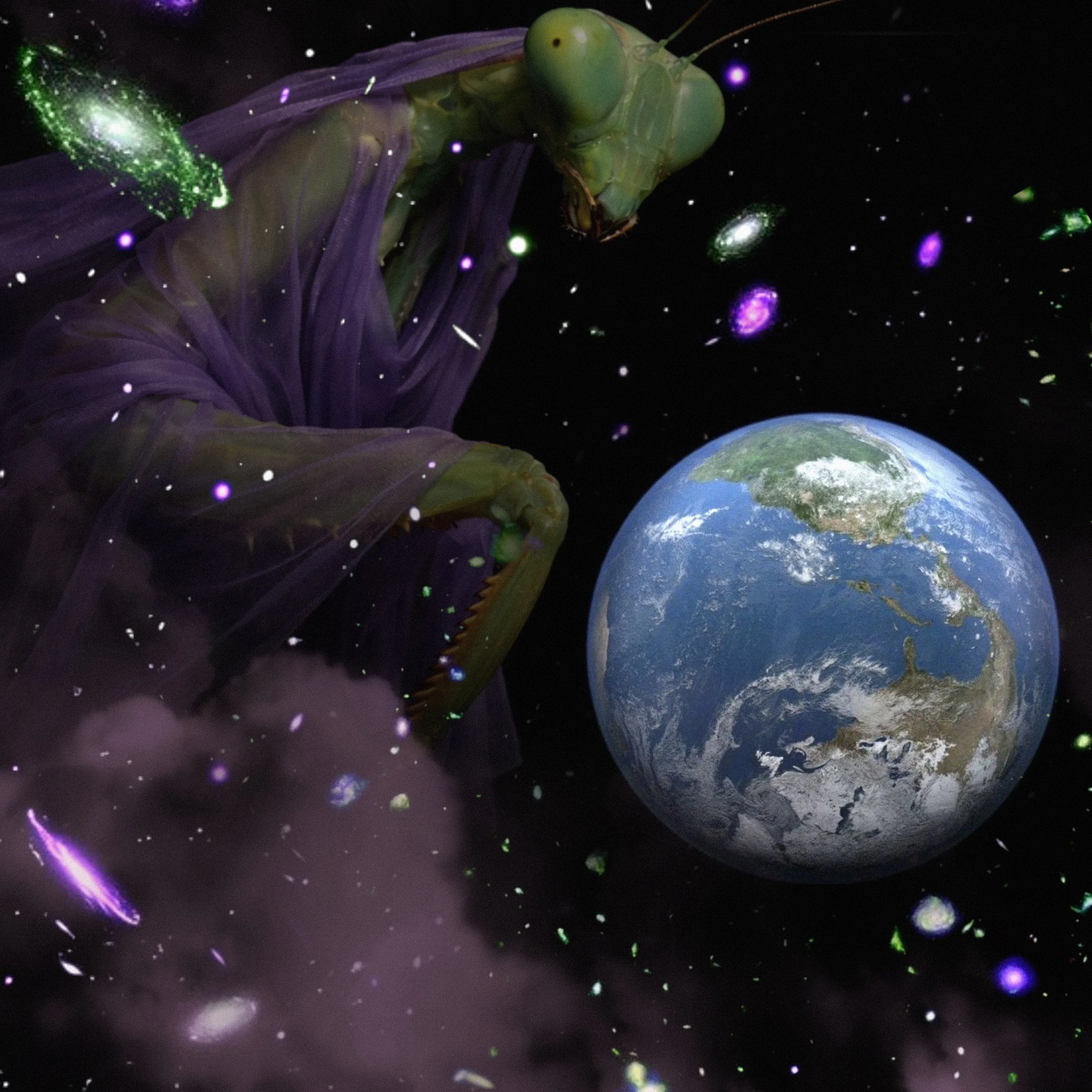
PHENOLOGICAL CONTINUITY
This article adopts the position that Earth is a constructed and cultivated environment, a planetary-scale germination system in which life, consciousness, and identity are generated, stressed, refined, and redistributed through repeatable cycles.
PHENOLOGICAL CONTINUITY
A specification for the planetary germination – agitation – maturation – graduation machine
The present thesis proceeds from a premise that is no longer radical to seasoned ufologists and is rapidly becoming unavoidable to newcomers to the disclosure age: Earth does not behave as an isolated system. It does not behave biologically, historically, or phenomenologically as a closed experiment, nor does human consciousness develop in a manner consistent with purely endogenous causation. The cumulative record, ranging from ancient cosmologies and religious texts to contemporary encounters, abduction literature, aerospace anomalies, and the persistence of non-human intelligences interacting with human perception, points not merely to visitation, but to stewardship, modulation, and long-duration involvement. The error has been to treat these indications as episodic incursions rather than as expressions of an continuous operating environment.
What follows is not an argument for the existence of non-human intelligences. That question has already passed its useful phase. Nor is this an attempt to rehabilitate fear, awe, or rebellion as default responses to scale. The aim is to establish posture. One does not meaningfully interpret a machine while emotionally resisting its existence. The posture required here is closer to technical sobriety than spiritual shock, and closer to maturity than comfort. Death, in this sense, is not an endpoint but an orientation tool: the relinquishing of the assumption that human continuity, human centrality, or even human comprehension is guaranteed or required for participation in a larger system. Those who have cultivated this posture already understand that clarity increases as attachment loosens.
The disclosure moment has produced a peculiar dissonance. On the one hand, public figures, institutions, and media outlets express dread at the implications of non-human oversight, as though the universe had suddenly violated an implicit promise of gentleness. On the other hand, human culture has long entertained fictions populated by genocidal gods, cosmic indifference, extinction-level events, and realities far harsher than anything presently suggested by empirical data. The notion that truth must be less severe than imagination betrays an adolescent expectation about reality. The cosmos has never offered such assurances. That it is structured, layered, and inhabited by intelligences operating at scales and dimensionalities unfamiliar to us is not an insult; it is a correction.
This article adopts the position that Earth is a constructed and cultivated environment, a planetary-scale germination system in which life, consciousness, and identity are generated, stressed, refined, and redistributed through repeatable cycles. These cycles are not random. They exhibit patterns consistent with experimental iteration, selective pressure, memory retention, and long-term objectives that exceed the lifespan of civilizations. Within this framework, human beings are neither prisoners nor protagonists in the theatrical sense. They are operators, substrates, and emergent agents within a maturation process that privileges continuity over sentiment.
The intelligences governing this system do not appear as a unified class, but as a stratified order whose roles are revealed through regulation, intervention, and preservation rather than proclamation. They are not bound to terrestrial constraints, nor do they appear limited to a single morphological or dimensional expression. The beings commonly labeled as extraterrestrials, including the entities colloquially known as Greys, are best understood as intermediaries, instruments, or specialized participants within this broader custodial ecology. Whether they correspond to categories described in ancient texts, such as the Igigi, or represent adaptive forms designed for interface and data acquisition, is secondary to their role: participation in a managed environment whose primary output is differentiated consciousness.
Genesis, the Book of Enoch, the Emerald Tablets attributed to Thoth, the Bhagavad Gita, and plenty other references converge on a shared assertion when stripped of doctrinal embellishment: life is not accidental, death is not terminal, and individuality is not erased by participation in a greater order. Rather, individuality is preserved, measured, and repositioned. The soul, described variously as imperishable, atomic, or eternal, undergoes transitions not as punishment or reward but as part of a continuous operational flow. Birth and death are not symmetrical bookends but interfaces, moments of ingress and egress within a system designed for movement.
This orientation demands composure. The shock of Truth is not evidence of malevolence; it is merely evidence of scale. To encounter a reality that does not prioritize human comfort doesn’t have to be a hostile encounter. The task, then, is literacy: learning to read the machine while standing inside it. What follows is a specification of that machine, articulated without apology and without the expectation of universal agreement, for those prepared to think at planetary and post-planetary scales.
The Phenological Machine
To speak of Earth as a machine is not to invoke metal, gears, or intention in the anthropomorphic sense. It is to describe a system whose outputs are measurable, whose cycles are repeatable, and whose tolerances are precise. Phenology, in biological science, refers to the timing of life events in response to environmental conditions. The term is retained here, but expanded. What is being described is not merely the seasonal behavior of organisms, but the patterned emergence, modulation, and redistribution of consciousness across temporal strata. Earth functions as a phenological engine in which matter, memory, identity, and perception are brought into alignment for the purpose of differentiation.
The most persistent mistake in cosmological anthropology has been the conflation of intelligence with personality. Human beings look for faces, motives, moods. Machines look for signal integrity. The system governing terrestrial life exhibits the latter. It does not persuade; it pressures. It does not reward virtue in the moral sense; it selects for coherence, adaptability, and signal density. Species rise and fall not because they are loved or hated, but because they meet or fail the operating thresholds required for continued participation. Extinction, in this framework, is not annihilation but decommissioning. The material form is withdrawn when its yield no longer justifies its energetic cost.
At the core of the phenological machine is germination. Germination is not metaphorical here. It is the primary function. Consciousness is seeded into matter under constrained conditions: gravity, scarcity, mortality, pain, reproduction, memory loss. These constraints are not defects. They are the pressure chamber. Under sufficient pressure, low-order awareness fractures, differentiates, and begins to exhibit traits that cannot arise in unconstrained environments: empathy, creativity, foresight, symbolic abstraction, self-reflection. The planet provides the necessary stressors. Culture provides secondary refinement. Catastrophe provides pruning.
Reincarnation, stripped of devotional language, is a load-balancing protocol. Consciousness is recycled not because it is trapped, but because it is useful. Memory is attenuated not as punishment, but to prevent feedback saturation. A system that allowed full recall across iterations would collapse into recursive fixation. Identity would harden. Adaptation would cease. Forgetting is therefore a feature, not a flaw. What persists across cycles is not narrative memory but structural imprint: tendencies, affinities, aversions, capacities. These are the conserved variables.
The Custodial layer does not micromanage outcomes. It tunes parameters. Climate oscillations, geomagnetic shifts, genetic bottlenecks, cultural accelerants, and technological inflection points appear not as random disasters but as corrective inputs. When a species or civilization approaches a state of runaway imbalance, the system responds. Sometimes the response is gentle: ideological mutation, symbolic reorientation, mythic correction. Sometimes it is severe: flood, fire, ice, impact. The historical record shows no preference for mercy over function. Survival is granted to what remains compatible.
Non-human intelligences interact with this machine in differentiated roles. Some observe. Some intervene. Some harvest data. Some act as interface layers between dimensions that do not naturally overlap. The entities reported in abduction and contact phenomena often display a curiously limited affect, a procedural demeanor, and a fixation on biological and neurological metrics. This has been misinterpreted as coldness. It is more accurate to say that they are not operating at the level of individual narrative significance. They are technicians within a system that outlives civilizations.
This reframes the perennial question of control. Humanity is neither free in the libertarian sense nor enslaved in the theatrical sense. It is constrained within a developmental corridor (I posit that most of us cannot live long away from Gaia in our Earth bodies). Free will operates locally, within boundary conditions. Choices matter, but not all choices are available. A seed may grow crooked or straight, but it will not become a fish. The corridor itself is non-negotiable. What is negotiable is the quality of coherence achieved within it. That’s important.
The increasing visibility of anomalous phenomena in the present era correlates with a phase transition in the machine. Human technology has reached a point where it begins to externalize cognition. Artificial intelligence, networked sensing, planetary-scale computation, and memory persistence represent a threshold. The system is responding accordingly. Disclosure is not a moral awakening; it is a synchronization event. When a substrate becomes capable of perceiving the machine, the machine permits itself to be perceived. Not all at once. Not without distortion. But enough to initiate acclimation. That’s going on now. Anecdotally, I was allowed to remember the presence that helped me transition from the “other side” back into my body after my NDE; that knowing narrowed by operational trajectory.
Once the machine is recognized as a germination engine rather than a narrative stage, many long-standing paradoxes dissolve. The apparent cruelty of nature, the indifference of the cosmos, the recurrence of collapse, the persistence of consciousness across death, and the involvement of non-human intelligences all resolve into a single operational logic: continuity through refinement. I think this kind of awareness is critical for adaption to and tolerance for what we will surely experience in the coming years.
Genesis Is Not THE Beginning
Genesis does not present itself as speculative cosmology, nor does it read like a naïve attempt to explain existence from nothing. Its opening movements are technical, procedural, and curiously unconcerned with origin in the metaphysical sense. What it records is a sequence of separations enacted upon a field already in motion: light distinguished from darkness, waters from waters, the upper domain set apart from the lower. The emphasis is not on creation but on differentiation, on the enforcement of boundaries necessary for stability within a living system.
The language is operational. Distinction precedes description. Structure appears before narrative. Whatever the text is describing, it is not inventing matter but imposing order upon it, establishing zones of interaction and exclusion that allow subsequent processes to unfold without collapse. In this sense, Genesis aligns seamlessly with the logic of the phenological machine. It reads less like the beginning of reality and more like the documentation of a calibration event following a prior state of disorder or excess. Or terraforming.
This requires attention to sequence. Creation unfolds as a staged narrowing of possibility space. Each division reduces degrees of freedom while increasing cOhErenCe. Life becomes viable because limits are enforced. Constraint is the enabling condition. When read in this way, Genesis ceases to function as theology and begins to operate as memory. Memory of a reset perhaps, preserved in symbolic language resilient enough to survive cultural collapse. Its concern is not where the universe came from, but how a habitable order was restored and stabilized after a prior configuration failed to sustain itself. Or it was a raw zone ripe and ready for manipulation.
“And God said, Let there be a firmament in the midst of the waters, and let it divide the waters from the waters.”
— Genesis 1:6
This is not poetry for children. It is boundary language. The firmament is not metaphorical; it is infrastructural. A separation is enforced because separation is required for stability. Creation, in this frame, is calibration.
The same logic recurs wherever humanity’s oldest strata of memory remain least disturbed. In the Book of Enoch, the Watchers do not descend to create humanity, but to interfere with a process already underway. Their transgression is not framed as rebellion against God, but as unauthorized disclosure of technique.
“And they taught them charms and enchantments, and the cutting of roots, and made them acquainted with plants.”
— 1 Enoch 7:1
What is condemned here is not curiosity, but timing. Knowledge is introduced without containment. Metallurgy, measurement, cosmology, and reproductive manipulation appear together because they destabilize together. The consequence is systemic, not moral.
“And as men perished, they cried, and their cry went up to heaven.”
— 1 Enoch 8:4
The punishment that follows is administrative, not annihilatory. The Watchers are bound, archived, removed from circulation. They are not erased.
“Bind Azazel hand and foot, and cast him into the darkness… and cover his face that he may not see light.”
— 1 Enoch 10:4
This is protocol enforcement.
Genesis encodes the same logic, but with heavier obfuscation. The Garden is not paradise. It is a controlled environment. Access is limited. Knowledge is gated. The transgression is premature system access.
“But of the tree of the knowledge of good and evil, thou shalt not eat of it: for in the day that thou eatest thereof thou shalt surely die.”
— Genesis 2:17
The “death” that follows is not immediate physical cessation. It is separation from direct access. Humanity is expelled from the environment where knowledge and being are unified, not out of spite, but because awareness has accelerated beyond the enclosure’s tolerance.
“So he drove out the man; and he placed at the east of the garden of Eden Cherubims, and a flaming sword which turned every way, to keep the way of the tree of life.”
— Genesis 3:24
The flaming sword does not guard morality. It guards a boundary condition.
What follows in the biblical narrative is not salvation history, but degradation management. Lifespans collapse. Language fragments. Memory disperses. Humanity spreads geographically while coherence decays. The Tower of Babel is not hubris punished; it is bandwidth exceeded.
“And the Lord said, Behold, the people is one, and they have all one language… now nothing will be restrained from them.”
— Genesis 11:6
Unity without sufficient integration destabilizes any complex system. When coherence scales faster than the structures capable of containing it, continuity fails not through rebellion or hubris, but through overload. Meaning fractures so that civilization can persist without catastrophic overshoot, dispersing memory across language, culture, and symbol rather than allowing it to remain dangerously centralized. This dispersal is not a punishment but a corrective redistribution, ensuring survival at the cost of clarity.
It is precisely here that the so-called apocrypha sharpen what the canon softens. Enoch is not excluded because it is false, but because it is unbuffered. It names hierarchies, delineates functions, and records violations with a degree of specificity that resists mythic insulation. The text reads less like devotional scripture and more like an incident log, preserving procedural memory where theology would later prefer allegory.
Egypt answers this excess with a complementary strategy. Where Enoch records disruption, Thoth preserves continuity. He does not rule events, nor does he intervene in their unfolding. His role is archival. He weighs, measures, names, and records across reigns and collapses, ensuring that when coherence fails, intelligibility does not vanish with it. Writing, number, magic, and law converge under this function because each serves the same end: compressing structure tightly enough to survive systemic breakdown.
Thoth does not create the world. He ensures that when the world fractures, something legible remains.
Across these traditions, separated by geography and mythic language but aligned in function, the pattern resolves. Reality is already active. Intelligence is already present. What persists is not the act of creation, but the necessity of governance. Not invention, but regulation. Humanity emerges neither as accident nor as sovereign, but as a variable cultivated within a managed corridor of development.
Genesis, then, does not mark the beginning of existence. It stands as the first surviving checksum after a reset, a symbolic record of recalibration preserved in a form resilient enough to endure collapse.
Once this is recognized, the modern question of non-human intelligence shifts decisively. The issue is no longer whether something arrived from elsewhere, but whether anything ever departed at all. The world described by these texts is not visited episodically. It is managed continuously, with visibility modulated according to capacity and tolerance.
From this point, further abstraction becomes impossible. If Genesis preserves the logic of governance, then governance must be examined directly. The custodial roles implied by these texts must be named, not in devotional terms, but in functional ones.
Lords of the Cycles
If Genesis encodes custodianship rather than creation, then custodians must exist as a functional class. Not gods in the devotional sense, and not abstractions mistaken for metaphor, but intelligences tasked with regulation across discontinuous epochs. The ancient record is unambiguous on this point, even if later traditions attempt to soften it. The world is governed not by a single will acting uniformly, but by strata of authority operating within assigned domains, each constrained by limits above and below.
The earliest texts do not describe heaven as a monolith. They describe administration.
In Book of Enoch, the cosmos is explicitly hierarchical. Thrones, watchers, princes, and overseers are differentiated not by holiness but by jurisdiction. The Watchers are not creators, nor supreme arbiters. They are deployed, assigned, and recalled. Their fall is not rebellion against existence itself, but deviation from mandate.
“And the angels, the children of heaven, saw and lusted after them, and said to one another: ‘Come, let us choose us wives from among the children of men and beget us children.’”
— 1 Enoch 6:2
The language is procedural. These beings deliberate. They decide. They act in concert. What follows is not chaos born of evil, but instability born of unauthorized intervention. The Watchers introduce techniques humanity is not metabolically prepared to absorb: metallurgy, cosmetics, weaponry, astronomical timing, reproductive manipulation. The result is not enlightenment but amplification without restraint.
“And Azazel taught men to make swords, and knives, and shields… and there arose much godlessness.”
— 1 Enoch 8:1
This is not a moral complaint. It is a systems failure report. Capability outpaces integration. The corrective action that follows is containment.
“Bind them for seventy generations underneath the earth, even to the day of judgment.”
— 1 Enoch 10:12
They are not destroyed. They are archived. Removed from active circulation until conditions permit reintroduction or final resolution. This is not theology. It is governance logic.
Genesis preserves the same structure under heavier compression. The “sons of God” who take wives from the daughters of men are not poetic flourish. They are a degraded echo of the Watcher tradition, stripped of explicit hierarchy but retaining the core violation.
“The sons of God saw the daughters of men that they were fair; and they took them wives of all which they chose.”
— Genesis 6:2
The response is not wrath alone, but systemic reset.
“My spirit shall not always strive with man… yet his days shall be an hundred and twenty years.”
— Genesis 6:3
Lifespan reduction is not punishment. It is throttling. Complexity is reduced to preserve continuity.
What these texts describe, across cultures and centuries, is a governing class whose primary function is cycle management. They intervene, withdraw, recalibrate, and preserve. They are not omnipotent. They do not act freely. They operate under constraint. Their authority is real, but bounded.
Egypt preserves the same structure through a different lens. Thoth does not reign. He records. He measures. He arbitrates between orders. His authority derives not from force but from continuity. He ensures that what must survive collapse does so in encoded form.
“I am Thoth, the Atlantean, master of mysteries, keeper of records, mighty king, magician.”
— attributed to Thoth, later Hermetic tradition
Whether one treats such passages as literal, symbolic, or both, the function is consistent. Thoth is not a creator-god. He is a memory-bearing office. Writing, number, magic, and law converge because they all serve the same task: stabilizing meaning across resets.
Across Mesopotamia, Egypt, and the Levant, the same pattern emerges. There are higher-order intelligences concerned not with worship but with regulation. Their interest in humanity is conditional. Their interventions are selective. Their failures are corrected not by erasure, but by cycling.
This is where modern confusion enters.
When contemporary culture speaks of “aliens,” it collapses this stratified system into a single category and then debates their morality as if they were neighbors or invaders. The ancient record does not support this flattening. It describes an ecology. Lords of the Cycles at the top. Mediating intelligences beneath them. Operational agents below that. Humanity at the bottom, not as livestock, but as a variable whose stability matters to the whole.
The moral ambiguity that troubles modern readers is not an artifact of cruelty. It is a feature of scale. At this level, benevolence and exploitation are not opposites. Cultivation requires pruning. Preservation requires loss. Stability demands sacrifice, though not always by those who administer it.
What matters is not whether these Lords are good by human standards, but whether their function is consistent. Across the record, it is. They appear at thresholds. They withdraw after collapse. They preserve memory selectively. They enforce limits when acceleration becomes dangerous.
This reframes the entire question of contact. Humanity is not being introduced to non-human intelligence for the first time. It is re-encountering a regulatory layer that has always been present, now leaking back into visibility as symbolic memory and technical capacity begin to overlap again.
From here, the model must descend another layer. If the Lords of the Cycles operate at the level of governance and reset, then there must exist intelligences whose role is execution rather than oversight. Not archivists. Not judges. Operators.
That is where the Greys belong in the architecture, and why they appear so differently from the figures that preceded them.
Greys
The Greys do not arrive with myth, proclamation, or warning. They do not announce themselves into the symbolic register at all. They appear as interruption. As removal. As the sudden realization that something is happening without asking whether it should be understood.
This is the first mistake most analyses make: treating the Greys as messengers. They are not. Nothing about their presence suggests revelation. There is no cosmology offered, no narrative imparted, no explanation volunteered. Where ancient encounters overwhelm the human psyche with symbol and terror, Grey encounters do the opposite. They flatten the field. Emotion dampens. Thought narrows. Time loosens its grip. Meaning is suspended.
The encounter feels procedural because it is procedural.
Across testimonies, decades apart, cultures apart, belief systems utterly incompatible, the same qualities recur with disturbing consistency. The beings are diminutive, uniform, spare. Their movements are economical. Their attention is selective. They do not react to fear as fear, nor to pleading as plea. They proceed.
“They didn’t care what I was feeling. It was like I wasn’t there for me.”
— abductee testimony
This absence of relational engagement is often interpreted as cruelty, but cruelty requires intent toward the subject. What the Greys exhibit is indifference to subjectivity itself. The human is present as a system, not a person. Body, nervous system, reproductive capacity, perceptual bandwidth. These are the points of interaction. The self narrating the experience is collateral.
This explains the stark aesthetic of Grey encounters. The environments reported are consistently stripped of cultural residue. No ornament. No language. No symbols to interpret. Light without source. Surfaces without texture. Space without orientation. Where religious vision floods the psyche with archetype, the Grey encounter evacuates it.
“It was like being taken out of the story of my life for a while.”
— recovered-memory account
The phenomenon of missing time follows naturally from this. Memory is not erased in the dramatic sense. It is bypassed. Consciousness is sidelined because it is not the interface being addressed. When recall returns later, often under hypnosis or spontaneous intrusion, it arrives fragmented, uncanny, resistant to narrative cohesion. The mind struggles not because the event is hidden, but because it occurred outside the channels designed for meaning-making.
Hybridization accounts, so often sensationalized, become almost banal when viewed through this lens. They are not romances, invasions, or replacements. They are iterative adjustments. Material is sampled. Variants are tested. Outcomes are observed. Generational effects matter more than individual consent because the unit of concern is not the person, but the lineage.
“They showed me something growing. Not as my child. As something they were checking.”
— abductee account
This is where discomfort sharpens, and rightly so. The Greys do not behave as moral agents in the human sense. They behave as technicians working within a mandate that does not prioritize human dignity as an intrinsic value. This does not make them evil. It makes them unsuitable as interpretive anchors.
They are not the system’s voice. They are its hands.
This also clarifies why Grey encounters so often feel emotionally cold while remaining psychically invasive. Empathy would contaminate function. Individuality would introduce variability. Even aesthetic distinctiveness would invite symbolic projection. Uniformity, affect suppression, and behavioral minimalism reduce noise.
Our understanding of the Greys has no impact on their operations.
This operational role becomes clearer in encounters where other presences are implied but not engaged. Numerous accounts describe the Greys acting under observation, deferring at key moments, or freezing when thresholds are crossed. Authority exists above them, but it does not speak. Oversight is present, but distant. The same hierarchy described in ancient texts reasserts itself, inverted now in visibility: executors foregrounded, governors obscured.
Where antiquity preserved memory of the rulers, modernity has stumbled into contact with the instruments. This inversion is destabilizing because it removes narrative comfort. The Greys offer no story to metabolize the experience. Meaning must be reconstructed afterward, often unsuccessfully. Fear rushes in to fill the void, followed by myth, then ideology. The encounter itself remains stubbornly uninterpretable.
Seen clearly, the Greys are not ambassadors, invaders, or creators. They are an interface layer designed to touch what higher-order intelligences cannot touch directly without breaking the host system. They modulate biology, perception, and cognition while insulating the broader architecture from symbolic contamination.
Their sameness is not laziness. Their silence is not secrecy. Their emotional flatness is not malice. These are design constraints. Which is why attempts to extract ultimate intent from Grey encounters always fail. Intent does not reside at the level of execution. It resides upstream, in the strata concerned with continuity rather than adjustment. To follow that thread, the analysis must move away from operators and back toward preservation. Not toward those who act, but toward those who remember when action ends and cycles turn.
Thoth
Every cycle that collapses leaves behind debris. Most of it is useless. Tools corrode. Institutions vanish. Languages fracture into noise. What persists is not technology but pattern, not data but ratio. The function embodied by Thothexists precisely to preserve those ratios when everything else fails.
Thoth is consistently misread as a god of wisdom in the abstract, a patron of scribes, a quaint personification of intellect. This reading dissolves under pressure. Across Egyptian, Hermetic, and later syncretic traditions, Thoth does not innovate. He does not rule. He does not redeem. He measures. He records. He adjudicates continuity when memory collapses. His domain is not truth, but survivability of meaning across breaks.
This role appears explicitly in funerary and cosmological texts, where Thoth is not portrayed as savior but as registrar, the one who stands beside judgment without delivering it.
“Thoth, who is in the balance, who judges the two lands, who records the verdict.”
— Egyptian funerary formulation, Book of the Dead
The emphasis is procedural. Judgment occurs, but Thoth does not decide. He ensures that the decision is logged, weighed, preserved, and transmitted forward. In this sense, he functions less like a deity and more like a checksum against corruption. When cycles reset, what survives does so because it has been encoded into durable symbolic infrastructure: language, number, proportion, ritual sequence.
This is why writing, mathematics, magic, and law converge under Thoth’s office. They are not separate domains. They are compression strategies. Writing externalizes memory. Number abstracts relationship. Magic formalizes interaction between layers. Law stabilizes behavior under uncertainty. Each is a means of carrying high-order structure through conditions that annihilate surface detail.
The Hermetic traditions make this explicit, even when later readers mistake them for allegory.
“I am Thoth, the scribe of the gods, who preserves the words of power when the world is remade.”
— Hermetic attribution
Whether taken as literal transmission or mythic condensation, the function remains invariant. Thoth is not bound to a single civilization because civilizations are not the unit of concern. He persists across Egyptian, Greek, and later esoteric frameworks because the role he embodies must persist across resets. Names change. The office does not.
This clarifies the relationship between Thoth and the Lords of the Cycles. Where they regulate, Thoth remembers. Where they intervene, Thoth archives. Where they withdraw, Thoth ensures that something intelligible remains for the next iteration to recover. He is not the architect of cycles. He is the continuity bridge between them.
The contrast with the Grey interface is instructive. The Greys do not record. They do not preserve symbolic memory. Their interventions are clean, local, and forgettable by design. Thoth’s function is the opposite. He ensures that what must be remembered cannot be erased entirely, even when explicit memory becomes impossible. The system requires both. Execution without record produces amnesia. Record without execution produces stagnation.
This is why civilizations repeatedly rediscover the same structures without knowing where they came from. Sacred geometry resurfaces. Numerical harmonics reappear. Architectural proportions recur. Linguistic roots echo across unrelated cultures. These are not coincidences. They are artifacts of symbolic memory doing its work under constraint.
“The numbers are not new; they are remembered.”
— Pythagorean fragment, later tradition
From this angle, Thoth is less a figure and more a function instantiated wherever continuity is required. His presence marks places where collapse has occurred before, where something was salvaged and compressed tightly enough to survive. Egypt is not special because it was ancient. It is special because it sat atop a fault line between cycles and built its entire culture around remembrance.
This also explains why Thoth recedes from prominence as cycles mature. When continuity is stable, record-keeping becomes mundane. Bureaucracy replaces ritual. Libraries replace temples. Only when collapse approaches does the symbolic weight of record reassert itself, often mythologized again because literal preservation has failed.
Modern disclosure culture unconsciously reenacts this dynamic. Archives leak. Documents surface. Whistleblowers appear. Not to resolve the mystery, but to prevent total loss. The system does not suddenly become transparent. It sheds fragments, just enough to ensure that when the next reduction occurs, something remains to be recovered.
Thoth’s role, then, is not ancient history. It is ongoing. Wherever humans attempt to preserve meaning against institutional decay, informational overload, or cultural amnesia, the Thoth function reasserts itself. Sometimes as scripture. Sometimes as mathematics. Sometimes as classified memorandum. Sometimes as art. It’s a mistake to look for him as a person rather than recognize his office (which bears many names).
From here, the arc closes naturally. Once the functions of governance, execution, and preservation are visible, modern disclosure can be read as a symptom rather than a rupture. A pressure artifact produced when symbolic memory and technical capability begin to overlap again without a shared grammar.
Disclosure
Disclosure happens naturally. When pressure builds inside a system designed to manage visibility, the release does not arrive all at once. It blossoms as a diverse array of fissures, fractures and revelations. Documents surface without context. Testimony accumulates without authority. Data appears without interpretation. Institutions speak in half-statements that resolve nothing and erode trust. This is not incompetence. It is what regulated visibility looks like when symbolic memory and technical capacity begin to overlap without a shared grammar.
The modern fixation on “Disclosure” mistakes the symptom for the cause. The cause is misalignment. Too much capability has emerged too quickly for existing interpretive structures to metabolize, while too much symbolic residue has resurfaced to be dismissed as fantasy. The system responds not by clarifying, but by shedding fragments. Enough to prevent total amnesia. Not enough to collapse the buffer.
This is why Disclosure might feel so incomplete.
Every attempt to force it into a singular event fails. Hearings generate more questions than answers. Leaks confirm nothing cleanly. Evidence oscillates between compelling and deniable. The pattern frustrates both believers and skeptics because it refuses to resolve into either certainty or dismissal. That refusal is not accidental.
“We are not alone, and the data is real—but the full context remains unclear.”
— recurrent phrasing across official statements
Clarity is withheld not because the truth is explosive, but because premature coherence is destabilizing. A civilization that receives high-order information without proportional symbolic integration does not ascend. It fractures. History has already tested this failure mode repeatedly. The system does not repeat experiments that terminate the subject.
Modern disclosure mirrors ancient revelation in form, not content. Where prophecy once arrived through visions and voices, it now arrives through radar tracks, sensor anomalies, and declassified memoranda. The medium has changed. The logic has not. Information appears at the edge of undeniability, always one step short of forcing consensus.
“There are objects in our airspace that we cannot identify.”
— contemporary military testimony
This statement carries the same functional weight as ancient declarations of divine encounter. It establishes anomaly without explanation. It destabilizes the map without offering a replacement. The system does not ask humanity to believe. It forces humanity to reconsider what belief even means under these conditions.
Disclosure culture often misreads this as cowardice or conspiracy. While human secrecy undoubtedly plays a role, it is not the primary driver. Even when information escapes institutional control, it fails to cohere. Narratives proliferate. Interpretations diverge. No single frame stabilizes. This is not because the truth is hidden. It is because truth, at this scale, does not stabilize cleanly.
“The phenomenon seems to respond to observation itself.”
— paraphrased researcher observation, recurring in multiple studies
This single insight quietly dismantles the expectation of clean disclosure. A system that interacts through consciousness cannot be revealed like a foreign object. Observation alters engagement. Attention changes behavior. Meaning feeds back into manifestation. Disclosure, in such a system, cannot be delivered as static information. It must be approached indirectly or not at all.
This explains the strange temporal quality of the present moment. Everything feels on the verge of revelation, yet nothing resolves. The sense of imminence persists without arrival. This is not a tease. It is the sensation of a threshold that is not crossed by announcement, but by adaptation. The system is not waiting for permission to appear. It is waiting for sufficient capacity to hold what is already present.
Ancient cycles ended when capacity failed catastrophically. Modern cycles are being tested for a different outcome. Whether humanity can sustain ambiguity without mythologizing it into dogma or reducing it into dead mechanism remains an open question. Disclosure is not the answer to that question. It is the stress test.
This is why the language surrounding disclosure feels increasingly hollow. No revelation satisfies. No denial reassures. The hunger for a singular moment of truth is itself a relic of linear thinking, incompatible with a system that operates through recursion, buffering, and partial release.
What emerges instead is quieter and more unsettling. A gradual shift in what explanations feel plausible. A slow erosion of certainty without immediate replacement. A re-weighting of experience, symbolism, and data into a field that cannot be mastered, only navigated.
Disclosure is not an event to anticipate but a condition that emerges as tolerance increases. The system has never revealed itself because it was never hidden in the way humanity imagines; it has been regulated, filtered, and refracted through forms appropriate to each cycle’s capacity. What is changing now is not the presence of non-human intelligence, but the human system’s ability to recognize its own position within a larger architecture. That recognition does not arrive with spectacle or confirmation, but through discomfort, fragmentation, and the gradual collapse of explanatory frameworks that can no longer sustain the pressure placed upon them. This, rather than any announcement or unveiling, is how disclosure actually proceeds.
Finale
If all of this feels unsettling, that is not a flaw in the theory. It is evidence that you are still awake.
The expectation, when confronted with non-human intelligence, planetary-scale systems, and custodial architectures older than civilization, is ontological shock. Panic. Dread. The quiet suspicion that the universe has been keeping secrets and that we were never meant to find out. This reaction is understandable, but it is also provincial. It assumes that meaning must always scale to human comfort, that reality ought to arrange itself politely around our nervous systems.
Nature has never agreed to this.
The same cosmos that casually births stars, collapses galaxies, and flings planets through vacuum at obscene speeds is not suddenly obligated to become gentle when consciousness notices it. If anything, consciousness is the risky experiment. Awareness is the unstable variable. Everything else has been doing just fine without us narrating it.
From this angle, the true shock is not that Earth is embedded in a larger system, but that we ever imagined it was not. The idea that we were alone, unobserved, unmanaged, and cosmically exceptional was always the more extravagant fantasy. A comforting one, perhaps, but extravagant nonetheless. The theory outlined here does not demote humanity. It contextualizes it.
You are not the center of the system, but you are not irrelevant either. You are participating in something far stranger and more interesting than a solitary life on a meaningless rock. You are part of a germination process whose scale makes our myths look like marginal notes and our sciences look like early instrumentation. That is not an insult. It is an invitation to maturity.
Yes, there are Lords of the Cycles. Yes, there are operators who treat biology like hardware and memory like a variable. Yes, collapse recurs, and meaning fractures, and continuity is enforced without asking permission. None of this is new. What is new is our proximity to seeing it clearly. The mistake would be to respond with despair or submission. The second mistake would be to respond with hubris. The correct response is curiosity sharpened by humility.
If consciousness is being cultivated under pressure, then pressure is not cruelty; it is refinement. If memory is attenuated, it is not because we are unworthy, but because full recall would break the instrument. If the system withholds spectacle, it is not because it fears us, but because spectacle freezes development into belief rather than understanding. So perhaps the better questions are not Who is in control? or What will happen to us? but simpler, stranger ones:
What does a species look like when it learns to coexist with mystery without demanding dominion over it?
What kind of intelligence can emerge when fear is no longer the default response to scale?
What happens when the recognition dawns that the waltz of planets and the birth of stars are not the main event, but background choreography for processes occurring at levels of organization we are only beginning to sense?
If this all feels absurd, good. Absurdity is often the mind’s last defense before perspective shifts. The universe is not a courtroom, a nursery, or a stage built for our redemption arc. It is an ecosystem. Vast, recursive, layered, and unsentimental. And like any ecosystem, it rewards organisms that learn to read its signals without insisting that it speak their language. Disclosure, then, is not an apocalypse. It is a coming-of-age problem. The machine does not require your belief. It does not need your permission. It does not even need your understanding. What it responds to is coherence: the ability to hold complexity without panic, to operate without final answers, and to recognize that participation in something immense is not a threat, but a privilege. After all, the mites on the forest floor are not diminished by the existence of the forest. They are sustained by it.
And for the first time in long time, many of us are beginning to look up with a grin and a fuck-around-and-find-out attitude! Be excited about Life!
I’m still revising my theory, and there is SO MUCH context I would like to add (especially about the Greys), but maybe this project warrants many additions and perhaps a team of eager minds. I think this theory is important. If you’ve got any suggestions, please don’t hesitate to drop me a line. I’m always open to collaboration! Cheers!

THE REINCARNATION MACHINE
A Unified Cosmology of the Hollow World, Subterranean Divinity, & the Manufacture of Souls
Abstract
This article advances a comparative model that I call the Reincarnation Machine. Drawing on three convergent witnesses — The Smoky God (Olaf Jansen’s interior-world travelogue), The Emerald Tablets of Thoth (Amentian initiatory doctrine), and The Book of Enoch (Enochian geocosmology and angelology) — I argue that these texts preserve a single architectural intuition: Earth functions as a hollow or semi-hollow organism whose interior hosts a stationary luminary and a hierarchy of custodians; souls are cycled through sub-terrestrial precincts of evaluation, healing, and re-encoding; the luminous field encountered in near-death experiences is the interface of this system. I correlate these claims with Tibetan bardo literature, regression material popularized by Dolores Cannon, and modern speculations regarding underwater entrances and ultraterrestrial custodians. The aim is not credulity but coherence; when disparate sources map to the same topology and procedure, a research program suggests itself.
I. Introduction: The interior as first principle
Across cultures, cosmological language repeatedly inverts common sense and places the sacred within. Enoch descends to “uttermost depths,” surveys treasuries of wind, pillars of heaven, and rivers of fire that empty into a great sea; Thoth is led “through the Halls of Amenti,” witnesses souls like flames that brighten, fade, and then return; Olaf Jansen sails through an aperture at the pole, enters a region vitalized by a central luminary he calls the Smoky God, and encounters a civilization that treats the interior sun as throne and altar. These three lenses converge upon a single intuition: life on the surface is not the whole theater; it is a training ground embedded within a larger interior ecology whose technical center is Light.
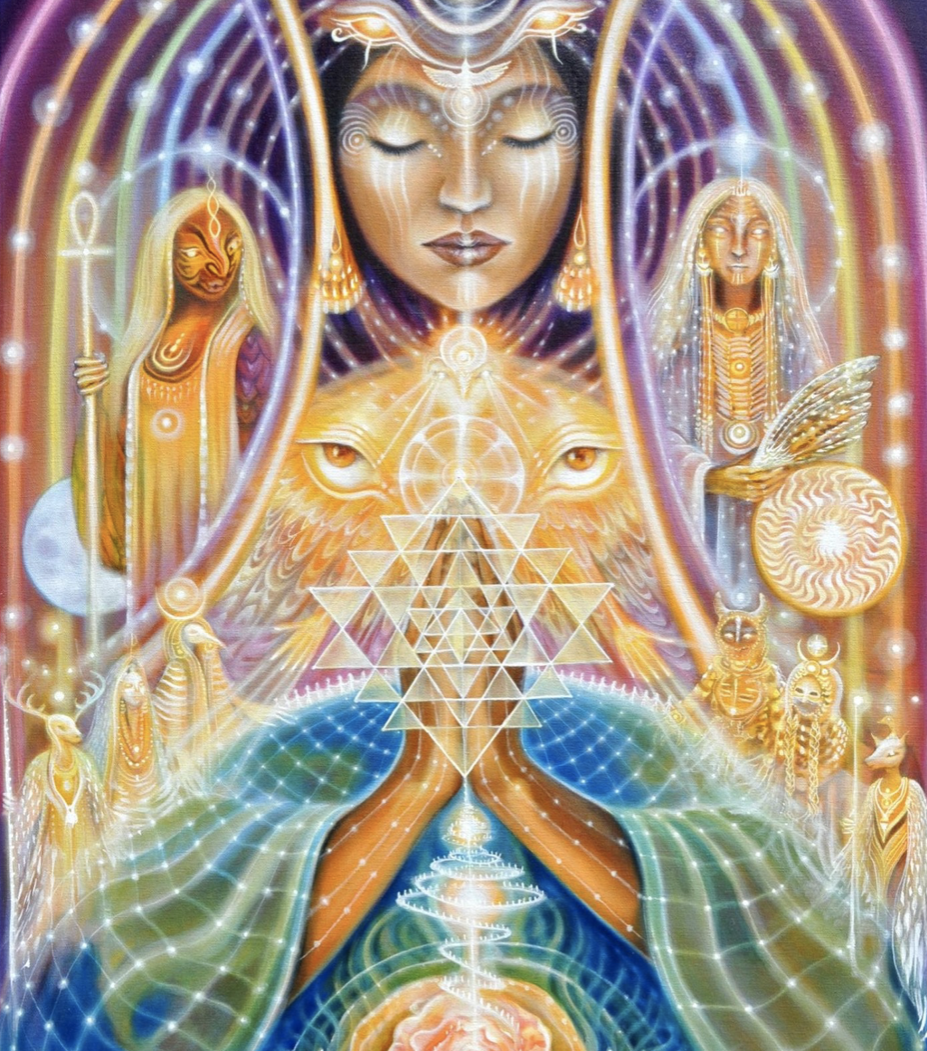
“The Halls of Amenti” by @tessa_mythos (IG)
II. Witness I: The Smoky God and the electric womb
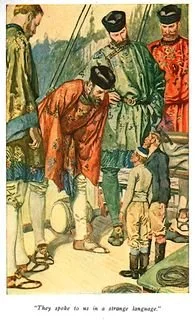
Jansen’s account is often dismissed as romance; yet its internal consistency and technical motifs deserve attention. He describes an aperture at the curve of the world, a crust roughly egg-shell thin by comparison, and an interior luminary that appears reddish at rise and set yet white at zenith; the inhabitants’ compass still points north even after crossing the aperture; the air is “electrically surcharged,” a constant vitalizer. The interior sun is pictured not as a nuclear star but as a suspended plasma cloud held in position by lawlike forces; nights display point lights that twinkle through openings in the supporting vault; day and night follow Earth’s rotation though the inner luminary is locally stationary. The Edenic capital, approached by advanced river craft that move silently and swiftly, functions as a sacral administrative center. Language affinities to Sanskrit are noted; governance is centralized; curiosity about the “without” is intense. If taken as a phenomenological record rather than a cartographic one, the picture reads as a working environment: a habitable cavity sustained by a charge-dominated luminary and optimized for biological vigor.
III. Witness II: The Emerald Tablets of Thoth and the halls of maintenance
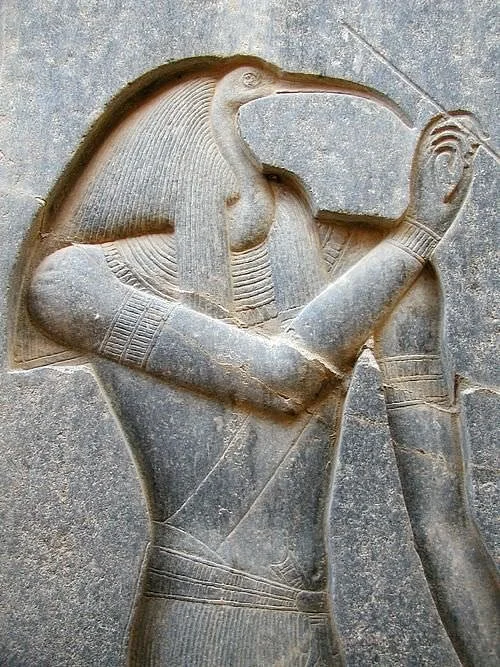
Thoth’s narrative is not a travel diary but an initiatory briefing. He is taken into hidden strata called Amenti; there “Lords of the Cycles” preside; a great throne of darkness veils a figure of night; Masters speak the Word that “brings Life unto Life.” Most striking is the didactic vision where uncounted flames stream from the veil of night; some flare like flowers; some fade swiftly; others grow from a small spark; a voice explains that these lights are souls among men, changing yet living, existing forever, blooming into flower and passing through death into life. Death is called an obstacle that is conquered by the infinite Light; the adept is told to “shine as a light among the children of men.” Read technically, Amenti is not merely a poetic underworld; it is a maintenance complex in which luminous intelligences oversee the recycling, healing, and amplification of soul-flame; it is the chamber where the parameters of the next embodiment are set. The vertical motions in the Tablets — downward for initiation, upward for return — mirror cyclic throughput.
IV. Witness III: The Book of Enoch and the geodesy of the deep
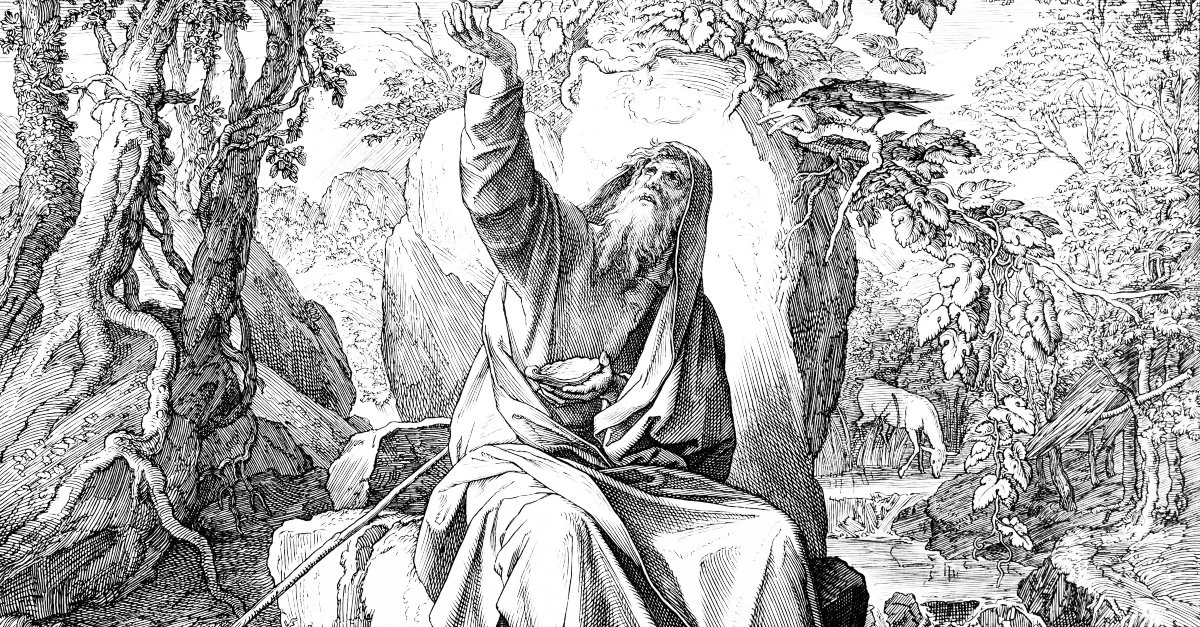
Enoch’s journeys are cartographic and juridical. He is led to living waters, to rivers of fire that discharge into a great sea, to mountains of winter darkness, to the mouths of rivers and the foundations of the earth. He sees the treasuries of winds that have their station between heaven and earth, the pillars on which the vaults rest, the winds that turn the circumference of sun and stars to their settings. He is shown hollow places prepared for the spirits of the dead until their appointed time; he hears a voice making suit to heaven; he catalogs archangels with designated jurisdictions: Uriel over the world and Tartarus; Raphael over the spirits of men; Michael over the best part of mankind and over chaos; Saraqael over spirits that err; Gabriel over Paradise and the serpents and the cherubim; Remiel over those who rise. Read mechanistically, Enoch describes a stratified interior full of fluid and fiery channels; hollow repositories that act as staging or quarantine; and a legal-angelic administration that governs movement through the system.
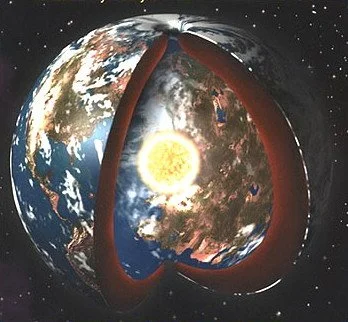
V. Comparative schema: one architecture, three vocabularies
Topology. All three witnesses place operative sancta beneath or within: an inner luminary in Jansen; underworld halls in Thoth; caverns, pillars, and treasuries in Enoch. 2) Power source. Jansen’s interior sun is electrical and suspended; Thoth’s Light is conquering and nutrifying; Enoch’s rivers of fire and pillars read as plasma conduits. 3) Administration. Jansen’s Edenic envoy, Thoth’s Lords of Cycles, and Enoch’s Archangels comprise homologous classes of custodians. 4) Procedure. Souls move downward for evaluation and reconfiguration, then upward for embodiment; this is explicit in Thoth, implicit in Enoch’s hollow places, and functional in Jansen where vigor and longevity are amplified under the inner luminary. 5) Phenomenology.Light is teacher, judge, and attractor; it is encountered as tunnel and sun; it organizes time and revolution.
VI. The Light as interface: NDEs, bardos, and the psychotronic field
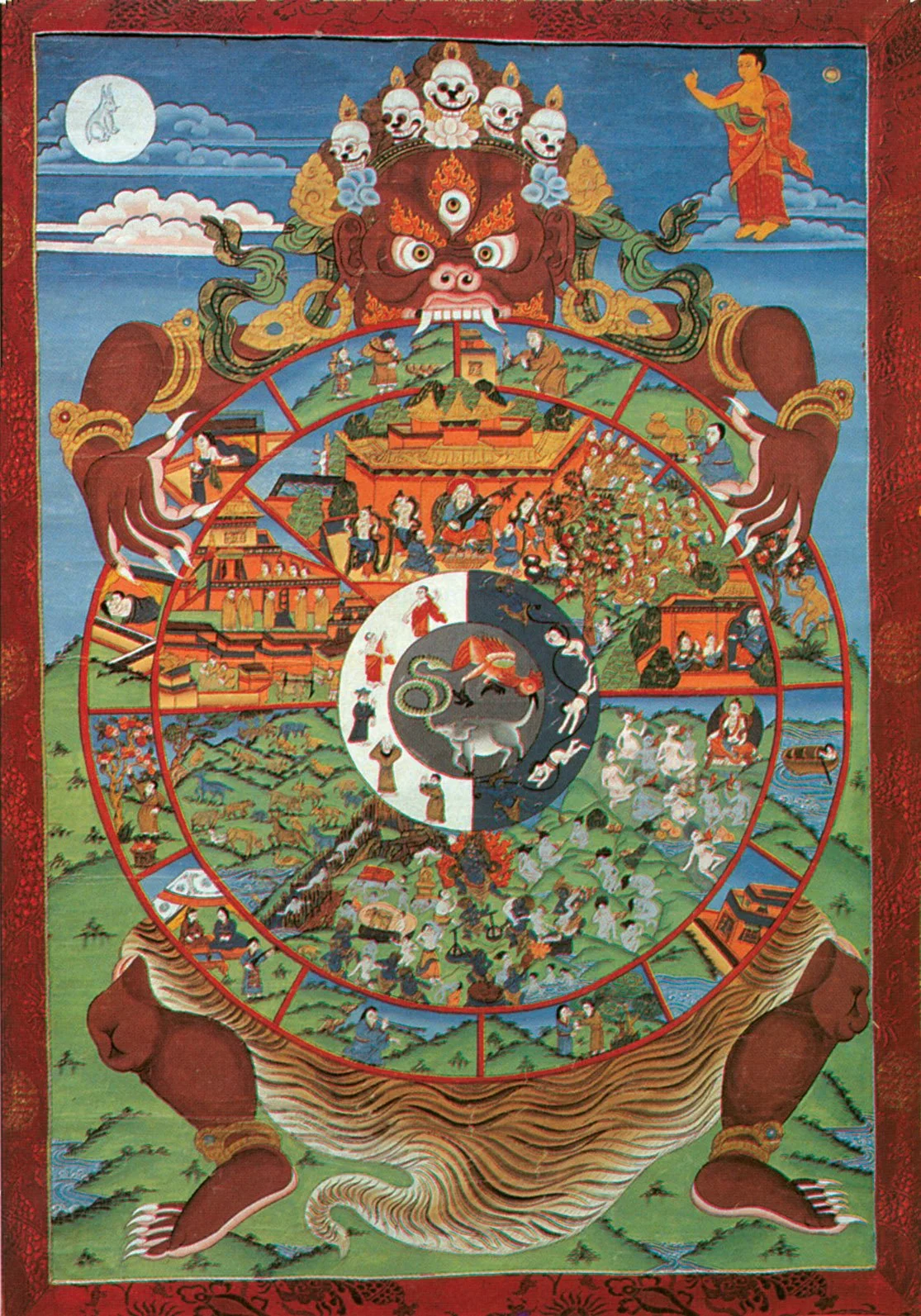
Modern near-death testimony repeatedly reports a tunnel or corridor of brilliance; contact with a Being of Light; panoramic review; subsequent return with altered values. Tibetan bardo literature instructs the newly dead to recognize the Clear Light at the moment of death and to avoid seductions of lesser lights that lead back to rebirth; the Clear Light is both the face of the Absolute and a passage that can be misread. In Thoth, the Master forbids the great figure of night from touching the initiate with the power of darkness and then unveils a hall filled with climbing flames that are souls; in Enoch, hollow repositories hold spirits until judgment; in Jansen, the inner sun is worshiped as throne and god, its radiation a tonic that extends life. I posit that these are culturally filtered encounters with a single phenomenon: a coherent luminous field that both evaluates and entrains consciousness. The tunnel is an attractor geometry; the review is a phase-matching of memory with the machine’s law; the return is a vector imposed when the soul’s learning curve requires further embodiment. The term “machine” does not trivialize the sacred; it stresses repeatability, structure, and parameters; it honors the intelligence embedded in creation.
VII. Ultraterrestrial engineering and access corridors
If the Reincarnation Machine is sub-terrestrial, ingress is required. Antiquity places gates at poles, mountains, and seas; Jansen enters by a polar aperture; Enoch notes regions where fire flows like water into a great sea; traditions of Agartha and Shambhala speak of subterranean cities and riverine tunnels; maritime anomalies and USO narratives hint that water masks entrances to sub-crustal volumes. The Emerald strata frame custodians as pre-terrestrial Elder Brothers; Enoch frames them as holy angels; modern narratives speak of Shining Ones, Devas, or Greys; the vocabularies differ yet the roles coincide. The operators appear concerned with the throughput of souls and the calibration of epochs; Thoth’s Lords of the Cycles imply timekeeping and mass transitions; Enoch’s archangels are assigned to world, chaos, judgment, resurrection. The hypothesis is ultraterrestrial rather than extraterrestrial; the relevant intelligence is domestic to Earth’s deeper architecture and only contingently aerial.
VIII. Toward a sacred physics of the interior luminary
If the interior sun is electrical, it is not a fusion core; it is a charge-confined plasma or photonic condensate held at the system’s center by pressure gradients and electromagnetic constraints. Such a luminary would produce diffuse illumination that is white at center and ruddy at limb; it would interact with the cavity’s atmosphere to generate stable circadian cues; point lights at night would be refractions through apertures and localized discharge events; the biotic consequence would be amplified vigor and longevity due to steady spectral distribution and higher negative ionization. Theologically, this inner sun is throne and altar; functionally, it is the pump that drives the reincarnation ecology; ethically, it is the witness that reviews and instructs. The same Light appears at death because the topological shortest path for an out-phasing neuroelectric pattern is toward the cavity’s attractor field. Mystics call this God; engineers might call it a planetary coherence engine.
IX. Procedure of the Machine: a working model

Dephasing. At bodily death the neural field loses biological anchoring; residual coherence couples to the planetary luminous field and is pulled into the tunnel configuration.
Evaluation. Within the field, memory is rendered in total simultaneity; judgment is not punitive but harmonic; dissonance between soul-tone and the Machine’s prime law manifests as instructive pain; consonance manifests as joy.
Treatment. Amentian technicians — call them Masters or Archangels — modulate the flame; traumas are absorbed into archetypal patterns; vows are negotiated; karmic entanglements are re-weighted.
Assignment. Trajectories are computed; parents, place, and epoch are selected by consent within constraints; the soul is encoded with tasks that enhance growth and serve the cycle.
Re-entry. The field redirects the soul through channels that appear as caverns, waters, or winds; the fetus receives the spark; amnesia hides the parameters to preserve free response.
This procedure synthesizes the explicit sequences of Thoth, the juridical staging of Enoch, and the technical ambience of Jansen’s world.
X. Implications for religion and science
The model reframes disputes that have divided theology and naturalism. Heaven and hell cease to be remote locations and become interior gradients within a single holy organism; angels are not mythic anomalies but operators of a lawful engine; miracles are stable technologies that look miraculous only from the surface. For science, the model invites plasma cosmology within geophysics, neurophotonics within consciousness studies, and serious fieldwork on luminous phenomena at polar latitudes and oceanic trenches. For history of religions, it permits a cross-mapping of bardo texts, Hermetic initiations, apocalyptic tours, and modern NDE literature without reducing any to metaphor.
XI. Testable corollaries and a research program
Scholars can approach the Reincarnation Machine proposition with falsifiable probes. 1) Geophysical anomalies. Look for persistent, rotation-locked electromagnetic features aligned with polar or bathymetric corridors; correlate with auroral substorms and low-frequency resonance in the Schumann spectrum. 2) Biological vigor under spectral modulation. Test whether life-extension markers increase under white-dominant, low-UV, high-ionization lighting regimens that mimic Jansen’s interior conditions. 3) Psychophysics of the Light. Model the tunnel and review using controlled near-death analogues and advanced neuroimaging; watch for coherent photonic emission and toroidal current patterns during threshold states. 4) Ethnographic concordance. Extend the present comparison to Tibetan bardo texts, Mesoamerican underworlds, Vedic lokas, and Theosophical Shambhala; code for topology, operators, procedure, and phenomenology. 5) Maritime reconnaissance.Catalog USO reports near subduction zones and polar shelves; instrument suspected corridors with magneto-hydrodynamic sensors that can detect anomalous charge flows.
XII. Phenomenological note: testimony of the Light
I have seen the tunnel and entered the Light; the encounter was not diffuse; it was precise and aware; its attention was instructional rather than possessive; memory unfurled as a single page yet every detail was legible; love and law were the same pressure; the invitation to return was not a command but a vector that made sense. When I read Thoth on the flames that bloom and the Master who forbids night from touching the initiate; when I read Enoch on hollow places where souls assemble and archangels who govern rising; when I read Jansen on a central luminary that nourishes and orders interior time; I recognize the same environment under different pedagogies. The Light is not merely an afterlife ornament; it is the working face of the Machine.
XIV. The Stellar Gate: Pyramid Texts and the Osirian Mechanism
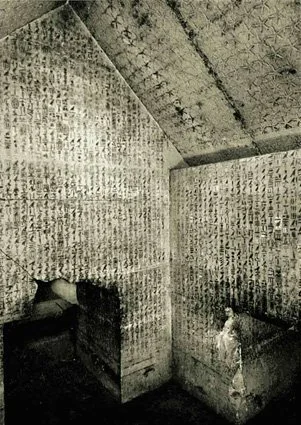
The Pyramid Texts in the tomb of Pharaoh Unas
The Pyramid Texts of the Old Kingdom constitute the oldest extant liturgy of technological resurrection. Etched into the walls of Saqqara’s stone corridors, they predate Mosaic revelation and Enochian apocalypse alike, yet they articulate the same architecture: the passage of consciousness through an inner-earth labyrinth toward an axial light that releases it into the stars. In Utterance 262 the king proclaims, “I ascend to the sky among the imperishable stars.” This is not allegory but description of a phase transition. The stellar ascension of Osiris is the completion of the cycle outlined by Thoth in Amenti and witnessed by Jansen within the Smoky God’s interior luminosity — the soul leaving the planetary chamber as coherent light.
Osiris himself functions as the anthropomorphic expression of the Machine’s regenerative principle. Dismembered and reassembled by Isis, he embodies the periodic disintegration and reconstitution of the luminous body. Each limb restored corresponds to a vibrational re-synchronization within the Light field; the green skin of Osiris symbolizes the recharged bioelectric vitality. Within Amenti, Thoth’s Master says, “I bring a Sun of the morning.” Within Egypt, that Sun is Osiris reborn as Horus — the same current turned outward through the stellar gate. The underworld is therefore not a prison but a service bay: a place where the flame is measured, tuned, and sent again to the heavens.
Architecturally, the pyramid itself is an interface. Its narrow shafts align precisely with Orion (the Osirian constellation) and Thuban or the circumpolar stars (the imperishables). In effect, the pyramid is a resonant vector guiding the liberated soul-light along precomputed celestial coordinates. The limestone casing, now lost, once functioned as a dielectric shell; the granite chambers below as piezoelectric nodes. When the king’s body was interred, the pyramid became an activated capacitor in the greater terrestrial circuit. The utterances were the programming syntax that synchronized the initiate’s consciousness with the machine’s field. In this sense, the pyramid is neither tomb nor monument but instrument — a transducer linking the microcosmic soul to the macrocosmic Light engine at Earth’s core.
The Osirian theology thereby completes the circuit implicit in this tri-textual synthesis. The Smoky God depicts the inner sun — the local field of incarnation; The Emerald Tablets describe the maintenance of that field — the underground halls of renewal; The Book of Enoch maps the governing intelligences and atmospheric conduits of transit; and the Pyramid Texts reveal the final phase — the stellar extrusion of matured soul-flame through calibrated geometry. Each tradition describes a different layer of the same apparatus: a global, perhaps interdimensional, biospheric womb whose purpose is the refinement of consciousness into stellar coherence.
Thus the Pyramid Texts are not relics of a primitive religion but blueprints of ascension physics. Osiris is the prototype of every soul processed through the Reincarnation Machine, and the pharaoh’s apotheosis as star formalizes what the Machine accomplishes for all humanity: the conversion of experience into light, of mortality into radiance, of time into energy returned to the Source(s). The pyramid stands as the fossilized interface of that process — a temple of transition built upon the memory of a deeper interior architecture still alive beneath our feet.
XIII. Conclusion: within the womb of a wise world
The three textual witnesses — Jansen’s inner geography, Thoth’s initiatory Amenti, Enoch’s angelic geodesy — resolve into one design. Earth is not only planet but temple; not only habitat but device; a sacred engine that matures consciousness by cycling it through luminous order. The Light is creator and creation at once; throne and pump; altar and algorithm. To speak of a Reincarnation Machine is to honor the intelligence of the cosmos without subtracting its holiness. If this synthesis is even partly true, Disclosure is secondary; the primary revelation is ultraterrestrial and intimate: we live within the instrument that makes us.
Selective references for further scholarly engagement
Emerson, Willis George. The Smoky God; or, A Voyage to the Inner World (1908).
Doreal, trans. The Emerald Tablets of Thoth the Atlantean; esoteric edition circulated mid-20th century; textual status contested yet influential.
Charles, R. H., trans. The Book of Enoch; early Jewish apocalyptic cosmography.
Bardo Thödol (Tibetan Book of the Dead); teachings on the Clear Light and bardos.
Cannon, Dolores. Between Death and Life; case studies on pre-birth planning and soul contracts.
Dolan, Richard. UFOs and the National Security State; discussions of USOs and submerged infrastructures.
The Ancient Secret of the Flower of Life by Drunvalo Melchizedek (comprehensive context)
Experiencer
What I’m going to tell you next is awkward for me, for it follows very clear impressions I had about military ops, possession tied to recovered materials, and psychic sorcerers plaguing the astral causeways."
Though my Communion experiences consciously started in July 2023, really bizarre experiences began to take shape in 2024. I was in the throes of a spiritual recalibration that culminated in me wanting to pursue some of the impulses that were welling up inside of me. Prior to this period, I’d been heavily absorbed in my studies of psychedelic therapy, having put myself through a rigorously routined psychedelic treatment using a protocol adapted from Paul Stamets. After watching things like Fantastic Fungi, How to Change Your Mind, and listening to proponents like Stamets, Weil, Trussell, Huberman, McKenna, and wrapping my head around many books (e.g., How to Change Your Mind) and studies (Johns Hopkins psilocybin research), I participated in Microdose.me blind research to develop a baseline and keep track of my progress. I used a small dose of dried cubensis paired with niacin and Lion’s Mane, four days on / three days off, for a solid ten weeks. I have never taken a routine more seriously in my life aside from feeding my babies on time and getting them to nap and to school on time.
My brain was already rebooting from previous psychedelic experiences, but the structured clinical approach to my health completely restructured the skeletons of my thoughts, my emotional body, and my general awareness. New waves of empathy, correlation, appreciation, and calm permeated me to my core, and all sorts of stuff in my genius brain began to integrate and talk to each other. I was becoming a superman. REALLY!
In this new mature mode of self-improvement, I found new interest in my mostly-obligatory meditation practices. I naturally wanted to be in my head more, and novel views began to overlay my old mapping and conceptions. Looking back, it’s hard to see any part of my story where the Visitors weren’t present. I was blind to miracles, too focused on the mundane qualities of my life to see the miraculous complexity we all swim in on a daily basis. But the wonder was building in me. Peace was finding me again. Innocence, childlike wonder, and the want to play!
Then the UFOs showed up. The orbs! July 28th, around 10 p.m. I’ve talked about it now in podcasts, spaces, interviews, etc. Before I knew other people were seeing them, and certainly before I had any kind of desire to see it, IT showed up! Hundreds of lights gently appeared for a time and vanished, coming from and going back into murky black like fish in deep water. It was not a passive spectacle; They showed up, zapped me, and went away. All I could do was sit there and smile, holding on tightly to the memory knowing that I had just been witness to a miracle that I never thought I was worthy of experiencing. I saw it with my eyes and felt it on my skin. We might as well have been hugging. I felt no distance. That feeling of missing out on the mystical left me. I felt I’d joined the ranks of the holy people who claim spiritual contact.
I tell people with a smirk that buying eggs the next day was a trippy experience, but at the time, it was no laughing matter. I actually got a type of vertigo being around people at the supermarket! New feelings and thoughts swirled through my head. It never dawned on me how strange it is, the human experience in the 20s. I was holding the eggs—pretty routine thing for me to buy—and upon hearing the bleeps at the self-checkout, taking in the variety of bipedal persons cavorting about in search of component novelties to blindly shove in their mouths... it was very disorienting. I can see how some people just derail from their normal lives after experiencing the sublime.
In short, my heart field was growing, my mind was healing and blossoming, UFOs started showing up to my house in different formes, and several presences made it obvious I was not alone; I was being guided and I had big things to figure out and participate in. Angels, yes. Obsessed with angels. But also, HER; The Lady; a divine, motherly figure that forced my nose into shame to stick a hot knife right into my soul, allowing the new empathy and compassion to reach my bones and veins. Some of those experiences will always be for me alone, not worth trying to put into words. But I accepted—quite gracefully, if I do say so myself—that I was no longer alone and this was not going to stop anytime soon. Frankly, in retrospect, my soul quietly asked for this. Finally, I felt useful and was on a path that resonated with me at my core. Though I didn’t ask for aliens, UAP, souls, or remote vision, in a way, I kind of did. I wouldn’t have it any other way now.
Fast forward to Contact in the Desert 2024. I was doing a little research on some of the speakers that were going to be present. I had watched a couple seasons of Ancient Alienswhen it came out back in the day, but kind of fell off, turning more to comics and movies, and sometimes periods of no media. I guess I wasn’t preoccupied with otherworldly beings and had decided that if there was anything out there—which I firmly believed based on the seeming magnitude of space—I didn’t care to analyze it beyond that. I certainly had the impression that the government was necessarily secretive, but had zero clue about the wealth of knowledge and lore in the Disclosure “movement.” So I wanted to be a little more informed before I introduced myself to people.
I just so happened to watch a Chris Bledsoe interview before my trip to California for the event. Had no clue who he was. I was more interested at the time with the testimonies of Commander Fravor and Ryan Graves. In fact, before my ‘encounter,’ I had one of my first jaw-dropping synchronicities (a word I’d soon learn was adjacent to Phenomenon and on everyone’s tongues). Every other day, I’d wake up and look up “something-something” news or some random celebrity’s net worth (mundane morning shxt); a curiosity arose: “Look up UFO news.” Several articles populated from 30 minutes prior. The internet was buzzing about Grusch! It’s still pretty nutty looking back at how things lined up. I have a hard time telling people all the details because I know how wild it seems. I experienced that firsthand at my shop with the first people that weren’t friends, about my orbs encounter. The guy I was doing a tattoo for was very interested, but his partner was very uncomfortable. In that moment, when I felt her reaction to my testimony—that she didn’t believe me but also felt nervous about what I was saying—I related to all the people I’d undermined in my skeptical past. I suddenly had joined the ranks of the tinfoil hat people and the nutters.
The moment my plane landed in California, I started seeing 111 everywhere. The highway number, my receipt, the time, the hotel address, the room number. Everywhere I looked: 111. I looked it up—“new beginnings,” “fresh starts.” I felt like it was my birthday, which had a lot to do with being on a kind of vacation. I’ve rarely had the chance to vacation for something unrelated to work of some kind. I was on a trip to learn about the scene, meet the people, take in some other experiences, and see where I fit with the whole Disclosure movement. I didn’t have any expectations beyond attending some lectures and having some California bud.
The first person I met at Contact was Bledsoe. After I checked into my room (111), I walked over to the resort to feel out the event and get my wristbands. After I got my packet, I walked downstairs and saw him sitting there talking to someone—there weren’t many people in the area at the time. My heart sank to my belly and I just started shaking, like I was the most nervous I’d ever been. I’ve met famous people; this was different. He just looked right into my eyes and I did what I always do: averted my eyes and walked away acting like I didn’t see him. I went and found somewhere to text. I’d messaged him after watching some of his interview and finding his Instagram, which only had a couple thousand follows at the time. I simply messaged him to ask if he was at Contact, to confirm that it was him. He responded immediately and told me he was there to spectate and that we could link up and chat at some point.
I walked around some more and got my footing, then scored a latte from upstairs in the café. After walking around a bit more, I took the elevator to the second floor, and when the elevator opened, Chris was sitting at a table right there talking with a lady. The nervousness came on again, and I wanted to go away to not bother him, but I surprised myself and walked right over to him to at least introduce myself. I apologized for interrupting, but he was so kind and welcoming, and he introduced me to the lady he was with, who happened to be someone in his group. I repeated that I’d love to catch up with him some other time when he wasn’t busy, and he insisted that I was not bothering him.
Then, the most surprising thing in the world… I quickly embraced him with a tight hug and he embraced me back. I started crying uncontrollably, too enraptured in the current passing from him into me to be embarrassed. I let him go and looked at him trying to apologize, to find that he had become emotional too. I could tell he was also confused but was feeling what I was feeling. The lady was in awe too, and she said it was beautiful, but I had to excuse myself. I walked away as he said we’d meet later, walked all the way back to room 111, plopped onto my bed face first, and cried so long that I got tired of crying and had no more tears to cry.
We met up several times to chat and I listened to his guest speaking. Contact was a total treat. But I came to realize in time that the whole reason I went there was for that meeting—specifically for the current he possessed. I learned this when I started reading The Ancient Secret of the Flower of Life (yet another powerful, right-on-time synchronicity), where Drunvalo Melchizedek explains how his angelic guides brought him to many places and people for attunement. He talked about being brought all the way to the company of Ram Dass only to touch his shoulder, was thrown back on his butt, and then told by his angelic companions that was it—time to move on to the next.
I was numb to how all this was playing out. I was on a mission, but the overwhelming feelings of miracle, timing, and unseen plans had me feeling like I had suddenly become an important millionaire or something. I felt like a celebrity, and all my fans are invisible.
A LOT has happened in that time, and while a full chronology of my connections and adventures with the “Phenomenon” might be necessary one day, I really want to focus on this element of an unseen host bringing certain persons together to produce some kind of either predestined or hyper-potential effect that the parts most likely will produce.
In the year following Contact ’24, I became deeply immersed in my meditative and magickal practices, initiating Contact on many levels, which consequently affected the depth and severity of my higher faculties: remote viewing, non-local affecter, akashic surfing, etc., chasing a narrative that seemed to manifest in the Zeitgeist as it entered my awareness. That there are so many people using the same lexicon and breathing the same story proves to me that this world is a mirage. It’s all so uncanny. In this period, I was led through processional learning by the Others, led to texts such as The Key by Whitley Strieber, The Emerald Tablets of Thoth, The Book of the Law, Kybalion, Gita, Jung, Thich Nhat Hanh (renewed vigor and intrigue), The Smoky God, Edgar Cayce, Damien Echols, Abraham Hicks, and much more!
I was getting quite good at traversing the cosmos “non-locally,” going places, seeing the high strangeness of the unseen, experiencing other kinds of life and presence and being. Some big life changes began to unfold for me in August ’24. Communion was getting really serious, and the connection with the Others began to cost me greatly. I was learning many hard lessons back to back to back, and my spirit was wearing thin (funny to look back at that now). My “angels” had convinced me to let my youngest son live full time with his mother instead of being torn between households; I learned that my ex was pregnant with my triplets and lost them at 6 months to an infection, which I found out from my mother who found out through a social media post—and I began retreating deeper and deeper into the Void to escape this place.
The CHANNELING became the most interesting phenomenon happening in my day to day. The data was just so spot on and intense, I had pretty much turned away from psychedelics’ initiatory processes for the endogenous experiences. I was all over the space-time, like a teenager with a new car and a pocket full of spending money lol. I wasn’t being reckless, but I was certainly dauntless, equipped with angelic and daemonic encounters that, frankly, did little to dampen the ego the angels were trying to entrain to resonance and equilibrium.
In August, I started receiving mildly distressing impressions of what seemed like military operations calling UAP and knocking them down and recovering them. These were layered impressions. I was also becoming aware of other PEOPLE who were doing what I was doing, but who were perhaps way better at it than me. I wonder if this was Their intention: to open me up to this arena, knowing the peril would not deter me and I would inevitably become as they—a node of practiced attunement in supernal places. I told my friends I was starting to feel this stuff.
In an automatic writing session (I started intuitively expressing my remote impressions variably) dated September 1, 2024, I wrote about Wilhelm Reich’s “cloudbuster” he used against cylindrical UAP, about the FDA court ordering his work to be burned, and Reich being murdered by the CIA. But the most interesting info that came through was as follows:
“Which remote viewers sell their souls to work as UFO poachers? Is cloudbuster perfected now? Yes. New, irresistible lures for UFO; very effective cat and mouse. Atlantis born again. Many descendants. Aiwass says, ‘No more teachers’.”
I told my friends what I was seeing. I told many people what I was experiencing and what I was seeing, but it didn’t line up with anything in the media, and I felt like maybe following all my “gut” impressions might lead to wild speculation.
In October, I went through a breakup before Halloween and was just completely numb, alone, and irritated with the Visitors for not intervening and helping me with my mortal life. I went through a bitter period. I went through the holiday season and made a few new guy friends, but was still dealing with a huge hole in my heart, despite being gifted a love connection with a twin-flame kind of gal. The emptiness wasn’t about loneliness or solitude; there was a deeper spiritual malaise, as if the experiences with the Others had bottlenecked to a non-phenomenon wherein the unimpeachable, insurmountable gap between us was never going to fill with anything interesting to my infinite mind. Looking back, I was being a big baby—but maybe that was part of it.
I was begging the Visitors for more overt connection. I wanted a face-to-face meeting, and I wasn’t getting it. I’d gone through a few experiences that seemed very much like they had come to my home and done things to me in my sleep. I documented it and even went for x-rays, just to have the physician tell me they had no idea how to proceed. It left me feeling really dumb.
What I’m going to tell you next is awkward for me, for it follows very clear impressions I had about military ops, possession tied to recovered materials, and psychic sorcerers plaguing the astral causeways. I will be most honest with you: I do not know why They show what they show, and I don’t always trust my first interpretations of things. They are wacky most of the time; capricious, playful, meticulously chaotic, and foreign. We cannot make firm conclusions by following Their train of thought, which only appears that way because of our orientation in time. They are extratempestrial, whoever they are. Quote from Close Encounters of the Third Kind: “There’s still so much we don’t know.” That Truth is eternal.
Jan 27, 2025.
I was going through a particularly tumultuous period. The holidays weren’t great, January wasn’t a great month for work, and I had bridges burning and all sorts of other stresses. I saw a singular orb one morning as I woke up. It was right outside my window. I saw it with my new girlfriend, and it sent me into a mental spiral—one of frustration and annoyance. I was so bothered by the nature of the apparitions; the lack of meaningful interaction (which stemmed from me wanting to play with another anthropomorphic entity that speaks my language and engages the universe like me lol—pretty primitive).
I was so frustrated, I started screaming at them. Anger, annoyance, frustration—all verbalized and projected at them. I’m embarrassed to explain this, because it highlights my nearsightedness at that time, and it wasn’t that long ago.
That night, in meditation, I warned the Others (ha!) that I was coming to look for Them! I was going to find their places, their vehicles, and their safety. Literally, the moment that I “set out,” I found myself FACE TO FACE WITH ANOTHER MAN! I knew they’d done it, because I sensed a casual, joking quality to their intervention here. Many of those impressions that I’d had about the UAP being brought down came along with the stark feeling of another person in my astral space. I “ran” back to my home, put up all sorts of cloaks and waves to hide myself. I was certain that whoever it was knew where I was and would find me again. Unless you’ve felt that place, you can’t relate. Those gut feelings arise all on their own when your perception visits non-corporeal reality.
I was pretty shaken.
I told my group of friends about this encounter but didn’t dwell on it (yet another one of those moments where I don’t want to overstep the boundaries of too much weird for uninitiated minds).
The next night, I had a dream of the man I’d encountered in the meditation. It was a totally bonkers dream—lucid and surreal. He was wearing a black suit and a glittery red party hat. All sorts of people—children, elf-like people, fuzzy people, generals, and many sorts of miscellaneous characters—were presenting various foreign shiny objects to him. He would take the items, analyze them unamused, and hand them back. Despite his lack of enthusiasm, the company of weirdos remained gleeful and happy.
I woke up the next morning (Jan 29th), dreams fading away as I entered my waking awareness, as often happens (I’m not much of a dream farmer). I turned my phone on and opened an app (maybe YouTube), and THE FIRST HUMAN FACE I SAW ON MY SCREEN WAS THE MAN!
I opened the video, which was a SkywatcherHQ video about their “psionic” asset, Michael Battista. There he was—right there in the real world. Just put yourself in my shoes. All the weird stuff, then this completely unique (to me) phenom! Hearing his voice, he sounded exactly how I thought he would. From the sighting of the orb to my frustrated temper tantrum to the dream to the video—it all came rushing into view: the “planned” intervention. Since that time, I’ve stopped losing “faith” in Them. I’ve stopped demanding they show up when I want. I’m no summoner. I’m just a person. My reverence was restored, and I became completely fascinated with the connection that they planted in me.
At some point, I was compelled to do a tarot reading for the man, whom I’d found on X (formerly Twitter). I pulled his cards and posted the reading on his profile. After that, he messaged me about the meaning of the reading and our friendship began. Shortly after that, things lined up to where he could visit me on the way to meeting with Skywatcher. Meeting him in real life was as profound a moment as seeing UFOs for the first time! He was not some dark sorcerer remote-viewing killer. Instead, he possessed another one of those special currents a la Chris Bledsoe. During his visit at my home, I felt the pressure of my qi amplified twofold. I had a pretty bad headache, but only because I could feel that I was going through some kind of change.
On his next visit, he brought another guy from Skywatcher who carried yet another current. An idea entered my mind during their visit: that so much world history will never be written. Some experiences just can’t be explained because there aren’t enough words. But those encounters restored my hope to a point where I can’t ever go back. I didn’t know I needed that human element, when I was “out there” seeking alien alliances and experiences.
This sequence of events led me more to the awareness that there is some sort of plan. NONE of the encounters that have happened were accidents. They were staged on an unseen level by highly, highly superior mind. I’ve grown a lot since incorporating the currents I’ve received. They have encouraged me to be in my power, and they have guided me, bolstered me, to fully express the immaculate gospel that is coming through from the zero-point place.
Since my friendship with Michael started, I’ve met many other people in this “circuit” that offer other vital pieces of the puzzle; who nudge me more and more in the direction of Destiny. At Contact in the Desert 2025, I met with Chris Bledsoe again and relished in more of his loving vibe. Michael connected me with a beautiful soul he worked with at Skywatcher, Jordan, whose energy was as comforting cotton. I got to conversate with David Hooper, a brilliant man with an intellect that towers out the top of his head. I met Astral, who is a vital player in the disclosure of mind and psi! I’m so honored to be in the stream; to call these souls brothers. And of course, my sweet, Melissa whom I'd met the previous year and had adventures of the heart with ♡
There’s still so much we don’t know, but I’m here to serve those who are fulfilling the Great Work!